


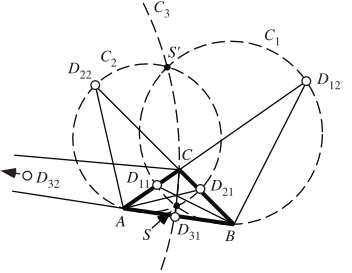
The first and second isodynamic points of a triangle  can be constructed by drawing the triangle's angle
bisectors and exterior angle bisectors.
Each pair of bisectors intersects a side of the
triangle (or its extension) in two points
can be constructed by drawing the triangle's angle
bisectors and exterior angle bisectors.
Each pair of bisectors intersects a side of the
triangle (or its extension) in two points  and
and  , for
, for  , 2, 3. The three circles having
 ,
,  , and
, and  as diameters are the
Apollonius circles
as diameters are the
Apollonius circles  ,
,  , and
, and  . The points
  and
and  in which the three Apollonius
circles intersect are the first and second isodynamic
points, respectively.
in which the three Apollonius
circles intersect are the first and second isodynamic
points, respectively.
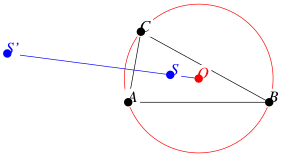
The two isodynamic points of a reference triangle  are mutually inverse
with respect to the circumcircle of
are mutually inverse
with respect to the circumcircle of  (Gallatly 1913, p. 103).
 and
and  have triangle center functions
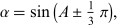 |
respectively. The antipedal triangles of both points are equilateral and have areas
![Delta^'=2Delta[cotomegacot(1/3pi)],](/images/equations/IsodynamicPoints/NumberedEquation2.svg) |
where  is the Brocard angle.
The isodynamic points are isogonal conjugates of the Fermat points. They lie on the Brocard axis. The distances from either isodynamic point to the polygon vertices are inversely proportional to the sides. The pedal triangle of either isodynamic point is an equilateral triangle. An inversion with either isodynamic point as the inversion center transforms the triangle into an equilateral triangle.
The circle that passes through both the isodynamic points and the triangle centroid of a triangle is known as the Parry circle.
