Goldbach's original conjecture (sometimes called the "ternary" Goldbach conjecture), written in a June 7, 1742 letter to Euler, states "at least it
seems that every number that is greater than 2 is the sum
of three primes" (Goldbach 1742; Dickson 2005,
p. 421). Note that Goldbach considered the number 1 to be a prime, a convention
that is no longer followed. As re-expressed by Euler, an equivalent form of this
conjecture (called the "strong" or "binary"
Goldbach conjecture) asserts that all positiveevenintegers can be expressed as the sum of
two primes. Two primes such that for a positive integer are sometimes called a Goldbach
partition (Oliveira e Silva).
According to Hardy (1999, p. 19), "It is comparatively easy to make clever guesses; indeed there are theorems, like 'Goldbach's Theorem,' which have never been
proved and which any fool could have guessed." Faber and Faber offered a prize to anyone who proved Goldbach's
conjecture between March 20, 2000 and March 20, 2002, but the prize went unclaimed
and the conjecture remains open.
Schnirelman (1939) proved that every even number can be written as the sum of not more than primes (Dunham 1990),
which seems a rather far cry from a proof for twoprimes!
Pogorzelski (1977) claimed to have proven the Goldbach conjecture, but his proof
is not generally accepted (Shanks 1985). The following table summarizes bounds such that the strong Goldbach conjecture
has been shown to be true for numbers .
bound
reference
Desboves 1885
Pipping 1938
Stein and Stein 1965ab
Granville et al. 1989
Sinisalo 1993
Deshouillers et al. 1998
Richstein 1999, 2001
Oliveira e Silva (Mar. 24,
2003)
Oliveira e Silva (Oct. 3,
2003)
Oliveira e Silva (Feb. 5,
2005)
Oliveira e Silva (Dec. 30,
2005)
Oliveira e Silva (Jul. 14,
2008)
Oliveira e Silva (Apr. 2012)
The conjecture that all odd numbers are the sum of three odd
primes is called the "weak" Goldbach conjecture. Vinogradov (1937ab,
1954) proved that every sufficiently largeodd number is the sum of three
primes (Nagell 1951, p. 66; Guy 1994), and Estermann
(1938) proved that almost all even numbers are the
sums of two primes. Vinogradov's original "sufficiently
large"
was subsequently reduced to by Chen and Wang
(1989). Chen (1973, 1978) also showed that all sufficiently large even
numbers are the sum of a prime and the product
of at most two primes (Guy 1994, Courant and Robbins
1996). More than two and a half centuries after the original conjecture was stated,
the weak Goldbach conjecture was proved by Helfgott (2013, 2014).
A stronger version of the weak conjecture, namely that every odd number can be expressed as the sum of a prime plus twice a prime
is known as Levy's conjecture.
An equivalent statement of the Goldbach conjecture is that for every positive integer ,
there are primes and such that
where
is the totient function (e.g., Havil 2003, p. 115;
Guy 2004, p. 160). (This follows immediately from for prime.) Erdős and Moser have considered dropping the
restriction that
and
be prime in this equation as a possibly easier way of determining if such numbers
always exist (Guy 1994, p. 105).
Other variants of the Goldbach conjecture include the statements that every even number
is the sum of two oddprimes,
and every integer the sum of exactly three distinct primes.
Let
be the number of representations of an even number as the sum of two primes.
Then the "extended" Goldbach conjecture states that


 can be expressed as the sum of
two primes. Two primes
can be expressed as the sum of
two primes. Two primes  such that
  for
for  a positive integer are sometimes called a Goldbach
partition (Oliveira e Silva).
a positive integer are sometimes called a Goldbach
partition (Oliveira e Silva).
 prize to anyone who proved Goldbach's
conjecture between March 20, 2000 and March 20, 2002, but the prize went unclaimed
and the conjecture remains open.
prize to anyone who proved Goldbach's
conjecture between March 20, 2000 and March 20, 2002, but the prize went unclaimed
and the conjecture remains open.
 primes (Dunham 1990),
which seems a rather far cry from a proof for two primes!
Pogorzelski (1977) claimed to have proven the Goldbach conjecture, but his proof
is not generally accepted (Shanks 1985). The following table summarizes bounds
primes (Dunham 1990),
which seems a rather far cry from a proof for two primes!
Pogorzelski (1977) claimed to have proven the Goldbach conjecture, but his proof
is not generally accepted (Shanks 1985). The following table summarizes bounds  such that the strong Goldbach conjecture
has been shown to be true for numbers
such that the strong Goldbach conjecture
has been shown to be true for numbers  .
.


 are the sum of three odd
primes is called the "weak" Goldbach conjecture. Vinogradov (1937ab,
1954) proved that every sufficiently large odd number is the sum of three
primes (Nagell 1951, p. 66; Guy 1994), and Estermann
(1938) proved that almost all even numbers are the
sums of two primes. Vinogradov's original "sufficiently
large"
are the sum of three odd
primes is called the "weak" Goldbach conjecture. Vinogradov (1937ab,
1954) proved that every sufficiently large odd number is the sum of three
primes (Nagell 1951, p. 66; Guy 1994), and Estermann
(1938) proved that almost all even numbers are the
sums of two primes. Vinogradov's original "sufficiently
large"  was subsequently reduced to
  by Chen and Wang
(1989). Chen (1973, 1978) also showed that all sufficiently large even
numbers are the sum of a prime and the product
of at most two primes (Guy 1994, Courant and Robbins
1996). More than two and a half centuries after the original conjecture was stated,
the weak Goldbach conjecture was proved by Helfgott (2013, 2014).
by Chen and Wang
(1989). Chen (1973, 1978) also showed that all sufficiently large even
numbers are the sum of a prime and the product
of at most two primes (Guy 1994, Courant and Robbins
1996). More than two and a half centuries after the original conjecture was stated,
the weak Goldbach conjecture was proved by Helfgott (2013, 2014).
 can be expressed as the sum of a prime plus twice a prime
is known as Levy's conjecture.
can be expressed as the sum of a prime plus twice a prime
is known as Levy's conjecture.
 ,
there are primes
,
there are primes  and
and  such that

 is the totient function (e.g., Havil 2003, p. 115;
Guy 2004, p. 160). (This follows immediately from
is the totient function (e.g., Havil 2003, p. 115;
Guy 2004, p. 160). (This follows immediately from  for
for  prime.) Erdős and Moser have considered dropping the
restriction that
prime.) Erdős and Moser have considered dropping the
restriction that  and
and  be prime in this equation as a possibly easier way of determining if such numbers
always exist (Guy 1994, p. 105).
be prime in this equation as a possibly easier way of determining if such numbers
always exist (Guy 1994, p. 105).
 is the sum of two odd primes,
and every integer
is the sum of two odd primes,
and every integer  the sum of exactly three distinct primes.
 be the number of representations of an even number
  as the sum of two primes.
Then the "extended" Goldbach conjecture states that
as the sum of two primes.
Then the "extended" Goldbach conjecture states that
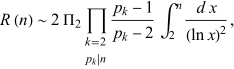
 is the twin primes constant (Halberstam and
Richert 1974).
is the twin primes constant (Halberstam and
Richert 1974).

 ." Oct. 3, 2003b.
  ." Math. Comput. 70, 1745-1750,
2001.Schnirelman, L. G. Uspekhi Math. Nauk 6, 3-8,
1939.Shanks, D.
." Math. Comput. 70, 1745-1750,
2001.Schnirelman, L. G. Uspekhi Math. Nauk 6, 3-8,
1939.Shanks, D.  ."
Math. Comput. 61, 931-934, 1993.Stein, M. L. and
Stein, P. R. "New Experimental Results on the Goldbach Conjecture."
Math. Mag. 38, 72-80, 1965a.Stein, M. L. and Stein,
P. R. "Experimental Results on Additive 2 Bases." BIT 38,
427-434, 1965b.Vinogradov, I. "Some Theorems concerning the Theory
of Primes." Recueil Math. 2, 179-195, 1937b.Vinogradov,
I. M. "Representation of an Odd Number as a Sum of Three Primes."
Comptes rendus (Doklady) de l'Académie des Sciences de l'U.R.S.S. 15,
169-172, 1937a.Vinogradov, I. M.
."
Math. Comput. 61, 931-934, 1993.Stein, M. L. and
Stein, P. R. "New Experimental Results on the Goldbach Conjecture."
Math. Mag. 38, 72-80, 1965a.Stein, M. L. and Stein,
P. R. "Experimental Results on Additive 2 Bases." BIT 38,
427-434, 1965b.Vinogradov, I. "Some Theorems concerning the Theory
of Primes." Recueil Math. 2, 179-195, 1937b.Vinogradov,
I. M. "Representation of an Odd Number as a Sum of Three Primes."
Comptes rendus (Doklady) de l'Académie des Sciences de l'U.R.S.S. 15,
169-172, 1937a.Vinogradov, I. M.