


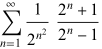
The Erdős-Borwein constant  , sometimes also denoted
  , is the sum of the reciprocals
of the Mersenne numbers,
, is the sum of the reciprocals
of the Mersenne numbers,
 |  |  |
(1)
|
 |  |  |
(2)
|
 |  |  |
(3)
|
 |  |  |
(4)
|
 |  |  |
(5)
|
 |  |  |
(6)
|
(OEIS A065442), where  is the divisor
function and
is the divisor
function and  is a q-polygamma
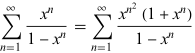
function. The transformation from equation (1) to (2) follows from the series
transformation
is a q-polygamma
function. The transformation from equation (1) to (2) follows from the series
transformation
 |
(7)
|
due to Clausen (Knuth 1998, pp. 155 and 157), with  .
.
Erdős (1948) showed that the constant  is irrational. Borwein
(1992) subsequently showed that
is irrational. Borwein
(1992) subsequently showed that
 |
(8)
|
with  is irrational.
Bailey and Crandall (2002, §5, p. 540) asked whether every finite binary word occurs in the binary
expansion of  , a property they called 2-density. Campbell (2026) proved
that the word 11 occurs infinitely often. The authorless
"Disjunctivity of the Erdős-Borwein Constant" (2026) claims that,
for every fixed binary word
, a property they called 2-density. Campbell (2026) proved
that the word 11 occurs infinitely often. The authorless
"Disjunctivity of the Erdős-Borwein Constant" (2026) claims that,
for every fixed binary word  , there is a constant
  such that
 |
(9)
|
for all sufficiently large  , where
  counts occurrences beginning among the first
  binary digits. Thus the claimed
lower bound implies that every finite binary word
occurs infinitely often in the binary expansion
of
binary digits. Thus the claimed
lower bound implies that every finite binary word
occurs infinitely often in the binary expansion
of  .
.
The accompanying Lean development checks the qualitative conclusion conditional on two explicit hypotheses on the distribution of prime numbers, but does not formalize the displayed quantitative lower bound. As of Sep. 8, 2026, no specialist review had been reported. VibeMathed (2026) classifies the work as AI-discovered and attributes it to GPT-6 Astra, but the released source does not identify an author or state an AI role.
