

The divergence of a vector field  , denoted
  or
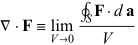
or  (the notation used in this work), is defined by
a limit of the surface integral
(the notation used in this work), is defined by
a limit of the surface integral
 |
(1)
|
where the surface integral gives the value of  integrated over a closed infinitesimal boundary surface
  surrounding a volume element
 , which is taken to size zero using a
limiting process. The divergence of a vector field
is therefore a scalar field. If
, which is taken to size zero using a
limiting process. The divergence of a vector field
is therefore a scalar field. If  , then the field is said to be a divergenceless
field. The symbol
, then the field is said to be a divergenceless
field. The symbol  is variously known as "nabla" or "del."
The physical significance of the divergence of a vector field is the rate at which "density" exits a given region of space. The definition of the divergence therefore follows naturally by noting that, in the absence of the creation or destruction of matter, the density within a region of space can change only by having it flow into or out of the region. By measuring the net flux of content passing through a surface surrounding the region of space, it is therefore immediately possible to say how the density of the interior has changed. This property is fundamental in physics, where it goes by the name "principle of continuity." When stated as a formal theorem, it is called the divergence theorem, also known as Gauss's theorem. In fact, the definition in equation (1) is in effect a statement of the divergence theorem.
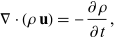
For example, the continuity equation of fluid mechanics states that the rate at which density  decreases in each infinitesimal volume element of fluid is proportional to the mass
flux of fluid parcels flowing away from the element, written symbolically as
decreases in each infinitesimal volume element of fluid is proportional to the mass
flux of fluid parcels flowing away from the element, written symbolically as
 |
(2)
|
where  is the vector field of fluid velocity. In the common case that the density of the
fluid is constant, this reduces to the elegant and concise statement
is the vector field of fluid velocity. In the common case that the density of the
fluid is constant, this reduces to the elegant and concise statement
 |
(3)
|
which simply says that in order for density to remain constant throughout the fluid, parcels of fluid may not "bunch up" in any place, and so the vector field of fluid parcel velocities for any physical system must be a divergenceless field.
Divergence is equally fundamental in the theory of electromagnetism, where it arises in two of the four Maxwell equations,
 |  |  |
(4)
|
 |  |  |
(5)
|
where MKS units have been used here,  denotes the electric field,
  is now the electric charge density,
  is a constant of proportionality known as the permittivity
of free space, and
is a constant of proportionality known as the permittivity
of free space, and  is the magnetic field. Together with the two other of the Maxwell equations, these
formulas describe virtually all classical and relativistic properties of electromagnetism.
is the magnetic field. Together with the two other of the Maxwell equations, these
formulas describe virtually all classical and relativistic properties of electromagnetism.
A formula for the divergence of a vector field can immediately be written down in Cartesian coordinates by constructing a
hypothetical infinitesimal cubical box oriented along the coordinate axes around
an infinitesimal region of space. There are six sides to this box, and the net "content"
leaving the box is therefore simply the sum of differences in the values of the vector
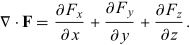
field along the three sets of parallel sides of the box. Writing 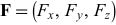 , it therefore following immediately that
 |
(6)
|
This formula also provides the motivation behind the adoption of the symbol  for the divergence. Interpreting
 as the gradient
operator
as the gradient
operator  ,
the "dot product" of this vector operator
with the original vector field
,
the "dot product" of this vector operator
with the original vector field 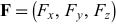 is precisely equation (6).
While this derivative seems to in some way favor Cartesian coordinates, the general definition is completely free of the coordinates chosen. In fact, defining
 |
(7)
|
the divergence in arbitrary orthogonal curvilinear coordinates is simply given by
![del ·F=1/(h_1h_2h_3)[partial/(partialu_1)(h_2h_3F_1)+partial/(partialu_2)(h_3h_1F_2)+partial/(partialu_3)(h_1h_2F_3)].](/images/equations/Divergence/NumberedEquation6.svg) |
(8)
|
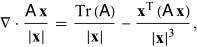
The divergence of a linear transformation of a unit vector represented by a matrix  is given by the elegant formula
 |
(9)
|
where  is the matrix trace and
  denotes the transpose.
The concept of divergence can be generalized to tensor fields, where it is a contraction of what is known as the covariant derivative, written
 |
(10)
|

 ." §1.7 in