


The curl of a vector field, denoted  or
or  (the notation used in this work), is defined as the vector
field having magnitude equal to the maximum "circulation" at each point
and to be oriented perpendicularly to this plane of circulation for each point. More
precisely, the magnitude of
(the notation used in this work), is defined as the vector
field having magnitude equal to the maximum "circulation" at each point
and to be oriented perpendicularly to this plane of circulation for each point. More
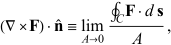
precisely, the magnitude of  is the limiting value of circulation per unit area. Written
explicitly,
is the limiting value of circulation per unit area. Written
explicitly,
 |
(1)
|
where the right side is a line integral around an infinitesimal region of area  that is allowed to shrink to zero via a limiting process and
  is the unit normal vector to this region. If
  , then the field is said to be an irrotational
field. The symbol
, then the field is said to be an irrotational
field. The symbol  is variously known as "nabla" or "del."
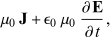
The physical significance of the curl of a vector field is the amount of "rotation" or angular momentum of the contents of given region of space. It arises in fluid mechanics and elasticity theory. It is also fundamental in the theory of electromagnetism, where it arises in two of the four Maxwell equations,
 |  |  |
(2)
|
 |  |  |
(3)
|
where MKS units have been used here,  denotes the electric field,
  is the magnetic field,
  is a constant of proportionality known as the permeability
of free space,
is a constant of proportionality known as the permeability
of free space,  is the current density, and
  is another constant of proportionality known as the permittivity of free space. Together
with the two other of the Maxwell equations, these formulas describe virtually all
classical and relativistic properties of electromagnetism.
is another constant of proportionality known as the permittivity of free space. Together
with the two other of the Maxwell equations, these formulas describe virtually all
classical and relativistic properties of electromagnetism.
In Cartesian coordinates, the curl is defined by
 |
(4)
|
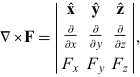
This provides the motivation behind the adoption of the symbol  for the curl, since interpreting
  as the gradient operator
  ,
the "cross product" of the gradient operator
with
,
the "cross product" of the gradient operator
with  is given by
 |
(5)
|
which is precisely equation (4). A somewhat more elegant formulation of the curl is given by the matrix operator equation
![del xF=[0 -partial/(partialz) partial/(partialy); partial/(partialz) 0 -partial/(partialx); -partial/(partialy) partial/(partialx) 0]F](/images/equations/Curl/NumberedEquation4.svg) |
(6)
|
(Abbott 2002).
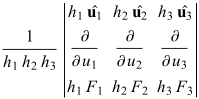
The curl can be similarly defined in arbitrary orthogonal curvilinear coordinates using
 |
(7)
|
and defining
 |
(8)
|
as
 |  |  |
(9)
|
 |  | ![1/(h_2h_3)[partial/(partialu_2)(h_3F_3)-partial/(partialu_3)(h_2F_2)]u_1^^+1/(h_1h_3)[partial/(partialu_3)(h_1F_1)-partial/(partialu_1)(h_3F_3)]u_2^^+1/(h_1h_2)[partial/(partialu_1)(h_2F_2)-partial/(partialu_2)(h_1F_1)]u_3^^.](/images/equations/Curl/Inline28.svg) |
(10)
|
The curl can be generalized from a vector field to a tensor field as
 |
(11)
|
where  is the permutation
tensor and ";" denotes a covariant
derivative.
is the permutation
tensor and ";" denotes a covariant
derivative.

 ." §1.8 in