


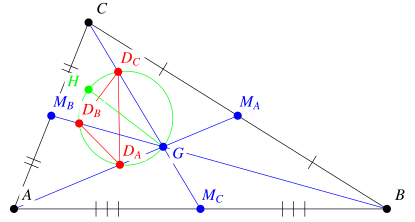
Let the circles  and
and  used in the construction of the Brocard
points which are tangent to
used in the construction of the Brocard
points which are tangent to  at
at  and
and  , respectively, meet again at
  . The points
  then define the
  -triangle, also known as the fourth Brocard triangle (Gibert).
It has trilinear vertex matrix
![[asecA 2c 2b; 2c bsecB 2a; 2b 2a csecC].](/images/equations/D-Triangle/NumberedEquation1.svg) |
(1)
|
The vertices of the  -triangle
are the isogonal conjugates of the second
Brocard triangle, and
-triangle
are the isogonal conjugates of the second
Brocard triangle, and  is inversely similar to the medial triangle (Johnson
1929, p. 285). In addition, the vertices lie on the respective medians of the
reference triangle. The circumcircle
of the
is inversely similar to the medial triangle (Johnson
1929, p. 285). In addition, the vertices lie on the respective medians of the
reference triangle. The circumcircle
of the  -triangle
is the orthocentroidal circle, which has
diameter
-triangle
is the orthocentroidal circle, which has
diameter  ,
where
,
where  is the triangle centroid and
  is the orthocenter.
The vertices satisfy
 |  |  |
(2)
|
 |  |  |
(3)
|
 |  |  |
(4)
|
(correcting Johnson 1929, p. 285).
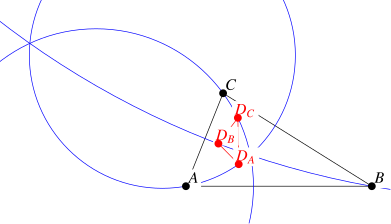
The vertices of the D-triangle lie on the respective Apollonius circles.
The following table gives the centers of the D-triangle in terms of the centers of the reference triangle that correspond to Kimberling
centers  .
.
 | center of the D-triangle |  | center of reference triangle |
 | circumcenter |  | midpoint of  and and  |
 | symmedian point |  | symmedian point |
 | first isodynamic point |  | first Fermat point |
 | second isodynamic point |  | second Fermat point |
 | far-out point |  | Parry point |
 | Parry point |  | triangle centroid |
 | Schoute center |  | center of Kiepert hyperbola |
 | isogonal
conjugate of  |  | direction of vector 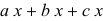 , where , where  |
 | isogonal
conjugate of  |  | crossdifference of line  and and  |
 | Collings transform of  |  | orthocenter |
 | radical center of (circumcircle, Brocard circle, Parry circle) |  | tripolar triangle centroid of
 |
 | isogonal
conjugate of  |  | point Biham |
 | isogonal
conjugate of  |  | isogonal conjugate of  |
