

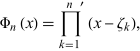
A polynomial given by
 |
(1)
|
where  are the roots of unity in
  given by
 |
(2)
|
and  runs over integers relatively prime to
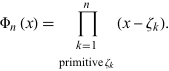
  . The prime may be dropped if the product is instead taken
over primitive roots of unity, so that
. The prime may be dropped if the product is instead taken
over primitive roots of unity, so that
 |
(3)
|
The notation  is also frequently encountered. Dickson et al. (1923) and Apostol (1975) give
extensive bibliographies for cyclotomic polynomials.
is also frequently encountered. Dickson et al. (1923) and Apostol (1975) give
extensive bibliographies for cyclotomic polynomials.
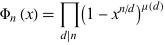
The cyclotomic polynomial for  can also be defined as
 |
(4)
|
where  is the Möbius function and the product is
taken over the divisors
is the Möbius function and the product is
taken over the divisors  of
of  (Vardi 1991, p. 225).
 is an integer polynomial and an irreducible
polynomial with polynomial degree
is an integer polynomial and an irreducible
polynomial with polynomial degree  , where
  is the totient function.
Cyclotomic polynomials are returned by the Wolfram
Language command Cyclotomic[n,
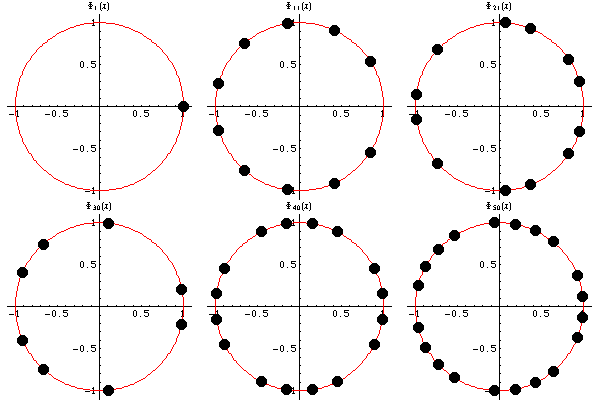
x]. The roots of cyclotomic polynomials lie on the unit
circle in the complex plane, as illustrated
above for the first few cyclotomic polynomials.
is the totient function.
Cyclotomic polynomials are returned by the Wolfram
Language command Cyclotomic[n,
x]. The roots of cyclotomic polynomials lie on the unit
circle in the complex plane, as illustrated
above for the first few cyclotomic polynomials.

The first few cyclotomic polynomials are
 |  |  |
(5)
|
 |  |  |
(6)
|
 |  |  |
(7)
|
 |  |  |
(8)
|
 |  |  |
(9)
|
 |  |  |
(10)
|
 |  |  |
(11)
|
 |  |  |
(12)
|
 |  |  |
(13)
|
 |  |  |
(14)
|


The cyclotomic polynomial  is illustrated above in the complex
plane.
is illustrated above in the complex
plane.
On any line through the origin, the value of a cyclotomic polynomial is strictly increasing outside the unit disk.
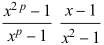
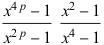
If  is an odd prime, then
 |  |  |
(15)
|
 |  |  |
(16)
|
 |  |  |
(17)
|
 |  |  |
(18)
|
 |  |  |
(19)
|
 |  |  |
(20)
|
(Riesel 1994, p. 306). Similarly, for  again an odd prime,
 |  |  |
(21)
|
 |  |  |
(22)
|
 |  |  |
(23)
|
For the first few remaining values of  ,
,
 |  |  |
(24)
|
 |  |  |
(25)
|
 |  |  |
(26)
|
 |  |  |
(27)
|
 |  |  |
(28)
|
 |  |  |
(29)
|
 |  |  |
(30)
|
 |  |  |
(31)
|
(Riesel 1994, p. 307).
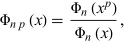
For  a prime relatively prime to
  ,
,
 |
(32)
|
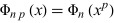
but if  ,
,
 |
(33)
|
(Nagell 1951, p. 160).
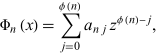
An explicit equation for  for squarefree
  is given by
 |
(34)
|
where  is the totient function and
  is calculated using the recurrence
relation
is calculated using the recurrence
relation
 |
(35)
|
with  ,
where
,
where  is the Möbius function and
  is the greatest
common divisor of
is the greatest
common divisor of  and
and  .
.
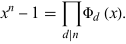
The polynomial  can be factored as
 |
(36)
|
Furthermore,
 |  |  |
(37)
|
 |  |  |
(38)
|
The coefficients of the inverse of the cyclotomic polynomial
 |  |  |
(39)
|
 |  |  |
(40)
|
can also be computed from
 |  |  |
(41)
|
 |  |  |
(42)
|
 |  | ![2/(sqrt(3))sin[2/3pi(n+1)],](/images/equations/CyclotomicPolynomial/Inline131.svg) |
(43)
|
where  is the floor function.
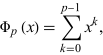
For  prime,
 |
(44)
|
i.e., the coefficients are all 1. The first cyclotomic polynomial to have a coefficient other than  and 0 is
  ,
which has coefficients of
,
which has coefficients of  for
for  and
and  . This is true because 105 is the first number to have
three distinct odd prime factors, i.e.,
. This is true because 105 is the first number to have
three distinct odd prime factors, i.e.,  (McClellan and Rader 1979, Schroeder 1997).
The smallest values of
(McClellan and Rader 1979, Schroeder 1997).
The smallest values of  for which
  has one or more coefficients
  ,
,  ,
,  , ... are 0, 105, 385, 1365, 1785, 2805, 3135, 6545, 6545,
10465, 10465, 10465, 10465, 10465, 11305, ... (OEIS A013594).
, ... are 0, 105, 385, 1365, 1785, 2805, 3135, 6545, 6545,
10465, 10465, 10465, 10465, 10465, 11305, ... (OEIS A013594).
It appears to be true that, for  , if
, if 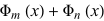 factors, then the factors contain a cyclotomic
polynomial. For example,
factors, then the factors contain a cyclotomic
polynomial. For example,
 |  |  |
(45)
|
 |  |  |
(46)
|
This observation has been checked up to  (Nicol 2000). If
  and
and  are prime, then
  is irreducible.
Migotti (1883) showed that coefficients of  for
for  and
and  distinct primes can be only
0,
distinct primes can be only
0,  .
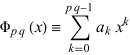
Lam and Leung (1996) considered
.
Lam and Leung (1996) considered
 |
(47)
|
for  prime. Write the totient
function as
prime. Write the totient
function as
 |
(48)
|
and let
 |
(49)
|
then
1.  iff
iff  for some
 ![i in [0,r]](/images/equations/CyclotomicPolynomial/Inline164.svg) and
and ![j in [0,s]](/images/equations/CyclotomicPolynomial/Inline165.svg) ,
,
2.  iff
iff  for
for ![i in [r+1,q-1]](/images/equations/CyclotomicPolynomial/Inline168.svg) and
and ![j in [s+1,p-1]](/images/equations/CyclotomicPolynomial/Inline169.svg) ,
,
3. otherwise  .
.
The number of terms having  is
is  , and the number of terms having
  is
is  . Furthermore, assume
  , then the middle coefficient
of
, then the middle coefficient
of  is
is  .
.
Resultants of cyclotomic polynomials have been computed by Lehmer (1936), Diederichsen (1940), and Apostol (1970). It is known that  if
if  , i.e.,
  and
and  are relatively prime (Apostol 1975). Apostol (1975) showed
that for positive integers
are relatively prime (Apostol 1975). Apostol (1975) showed
that for positive integers  and
and  and arbitrary nonzero complex numbers
  and
and  ,
,
![rho(Phi_m(ax),Phi_n(bx))=b^(phi(m)phi(n))product_(d|n)[Phi_(m/delta)((a^d)/(b^d))]^(mu(n/d)phi(m)/phi(m/delta)),](/images/equations/CyclotomicPolynomial/NumberedEquation14.svg) |
(50)
|
where  is the greatest common divisor of
  and
and  ,
,
 is the totient function,
  is the Möbius function,
and the product is over the divisors of
is the Möbius function,
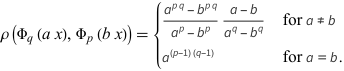
and the product is over the divisors of  . If
. If  and
and  are distinct primes
  and
and  , then (50) simplifies to
 |
(51)
|
The following table gives the resultants  ,
,  (OEIS A054372).
 | 1 | 2 | 3 | 4 | 5 | 6 | 7 |
| 1 | 0 | ||||||
| 2 | 2 | 0 | |||||
| 3 | 3 | 1 | 0 | ||||
| 4 | 2 | 2 | 1 | 0 | |||
| 5 | 5 | 1 | 1 | 1 | 0 | ||
| 6 | 1 | 3 | 4 | 1 | 1 | 0 | |
| 7 | 7 | 1 | 1 | 1 | 1 | 1 | 0 |
The numbers of 1s in successive rows of this table are given by 0, 0, 1, 1, 3, 3, 5, 4, 6, 7, 9, ... (OEIS A075795).
The cyclotomic polynomial  has the particularly nice Maclaurin
series
has the particularly nice Maclaurin
series
 |
(52)
|
whose coefficients 1, 0,  ,
,  , 0, 1, 1, 0,
  ,
,  , ... (OEIS A010892)
are given by solving the recurrence equation
, ... (OEIS A010892)
are given by solving the recurrence equation
 |
(53)
|
with  (Wolfram 2002, p. 128),
giving the explicit form
(Wolfram 2002, p. 128),
giving the explicit form
![a(n)=2/3sqrt(3)sin[1/3(n+1)pi].](/images/equations/CyclotomicPolynomial/NumberedEquation18.svg) |
(54)
|
Interestingly, any sequence  satisfying the linear
recurrence equation
satisfying the linear
recurrence equation
 |
(55)
|
can be written as
![b(n)=b(0)a(n)+[b(1)-b(0)]a(n-1).](/images/equations/CyclotomicPolynomial/NumberedEquation20.svg) |
(56)
|

 and
and  ." Math. Comput. 29, 1-6, 1975.Beiter,
M. "The Midterm Coefficient of the Cyclotomic Polynomial
." Math. Comput. 29, 1-6, 1975.Beiter,
M. "The Midterm Coefficient of the Cyclotomic Polynomial  ." Amer. Math. Monthly 71, 769-770,
1964.Beiter, M. "Magnitude of the Coefficients of the Cyclotomic
Polynomial
." Amer. Math. Monthly 71, 769-770,
1964.Beiter, M. "Magnitude of the Coefficients of the Cyclotomic
Polynomial  ."
Amer. Math. Monthly 75, 370-372, 1968.Bloom, D. M.
"On the Coefficients of the Cyclotomic Polynomials." Amer. Math. Monthly 75,
372-377, 1968.Brent, R. P. "On Computing Factors of Cyclotomic
Polynomials." Math. Comput. 61, 131-149, 1993.Carlitz,
L. "The Number of Terms in the Cyclotomic Polynomial
."
Amer. Math. Monthly 75, 370-372, 1968.Bloom, D. M.
"On the Coefficients of the Cyclotomic Polynomials." Amer. Math. Monthly 75,
372-377, 1968.Brent, R. P. "On Computing Factors of Cyclotomic
Polynomials." Math. Comput. 61, 131-149, 1993.Carlitz,
L. "The Number of Terms in the Cyclotomic Polynomial  ." Amer. Math. Monthly 73, 979-981,
1966.Conway, J. H. and Guy, R. K.
." Amer. Math. Monthly 73, 979-981,
1966.Conway, J. H. and Guy, R. K.  ." Amer. Math. Monthly 103, 562-564,
1996.Lehmer, E. "On the Magnitude of the Coefficients of the Cyclotomic
Polynomial." Bull. Amer. Math. Soc. 42, 389-392, 1936.McClellan,
J. H. and Rader, C.
." Amer. Math. Monthly 103, 562-564,
1996.Lehmer, E. "On the Magnitude of the Coefficients of the Cyclotomic
Polynomial." Bull. Amer. Math. Soc. 42, 389-392, 1936.McClellan,
J. H. and Rader, C.