


An  -gonal cupola
  is a polyhedron having
  obliquely oriented triangular
and
obliquely oriented triangular
and  rectangular faces separating an
  and a
and a  regular polygon, each
oriented horizontally. The coordinates of the base polyhedron
vertices are
regular polygon, each
oriented horizontally. The coordinates of the base polyhedron
vertices are
![(Rcos[(pi(2k+1))/(2n)],Rsin[(pi(2k+1))/(2n)],0),](/images/equations/Cupola/NumberedEquation1.svg) |
(1)
|
and the coordinates of the top polyhedron vertices are
![(rcos[(2kpi)/n],rsin[(2kpi)/n],z),](/images/equations/Cupola/NumberedEquation2.svg) |
(2)
|
where  and
and  are the circumradii of the
base and top
are the circumradii of the
base and top
 |  |  |
(3)
|
 |  |  |
(4)
|
and  is the height.

|

|

|
A cupola with all unit edge lengths (in which case the triangles become unit equilateral triangles and the rectangles become unit squares) is possible only for  , 4, 5, in which case the height
  can be obtained by letting
  in the equations (1) and (2)
to obtain the coordinates of neighboring bottom and top polyhedron
vertices,
in the equations (1) and (2)
to obtain the coordinates of neighboring bottom and top polyhedron
vertices,
 |  | ![[Rcos(pi/(2n)); Rsin(pi/(2n)); 0]](/images/equations/Cupola/Inline21.svg) |
(5)
|
 |  | ![[r; 0; z].](/images/equations/Cupola/Inline24.svg) |
(6)
|
Since all side lengths are  ,
,
 |
(7)
|
Solving for  then gives
![[Rcos(pi/(2n))-r]^2+R^2sin^2(pi/(2n))+z^2=a^2](/images/equations/Cupola/NumberedEquation4.svg) |
(8)
|
 |
(9)
|
Solving for  then gives
 |  |  |
(10)
|
 |  | 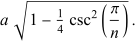 |
(11)
|
