

Let  and
and  be arbitrary functions of time
  with Fourier transforms.
Take
with Fourier transforms.
Take
 |  | =int_(-infty)^inftyF(nu)e^(2piinut)dnu](/images/equations/ConvolutionTheorem/Inline6.svg) |
(1)
|
 |  | =int_(-infty)^inftyG(nu)e^(2piinut)dnu,](/images/equations/ConvolutionTheorem/Inline9.svg) |
(2)
|
where  denotes the inverse Fourier transform (where
the transform pair is defined to have constants
denotes the inverse Fourier transform (where
the transform pair is defined to have constants  and
and  ). Then the convolution
is
). Then the convolution
is
 |  | 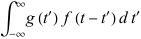 |
(3)
|
 |  | ![int_(-infty)^inftyg(t^')[int_(-infty)^inftyF(nu)e^(2piinu(t-t^'))dnu]dt^'.](/images/equations/ConvolutionTheorem/Inline18.svg) |
(4)
|
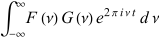
Interchange the order of integration,
 |  | ![int_(-infty)^inftyF(nu)[int_(-infty)^inftyg(t^')e^(-2piinut^')dt^']e^(2piinut)dnu](/images/equations/ConvolutionTheorem/Inline21.svg) |
(5)
|
 |  |  |
(6)
|
 |  | .](/images/equations/ConvolutionTheorem/Inline27.svg) |
(7)
|
So, applying a Fourier transform to each side, we have
![F[f*g]=F[f]F[g].](/images/equations/ConvolutionTheorem/NumberedEquation1.svg) |
(8)
|
The convolution theorem also takes the alternate forms
![F[fg]](/images/equations/ConvolutionTheorem/Inline28.svg) |  | ![F[f]*F[g]](/images/equations/ConvolutionTheorem/Inline30.svg) |
(9)
|
![F^(-1)(F[f]F[g])](/images/equations/ConvolutionTheorem/Inline31.svg) |  |  |
(10)
|
![F^(-1)(F[f]*F[g])](/images/equations/ConvolutionTheorem/Inline34.svg) |  |  |
(11)
|
