


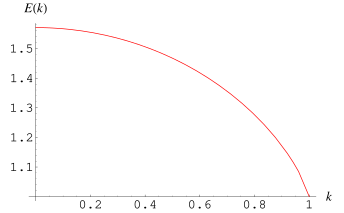


The complete elliptic integral of the second kind, illustrated above as a function of  , is defined by
 |  |  |
(1)
|
 |  | ![pi/2{1-sum_(n=1)^(infty)[((2n-1)!!)/((2n)!!)]^2(k^(2n))/(2n-1)}](/images/equations/CompleteEllipticIntegraloftheSecondKind/Inline7.svg) |
(2)
|
 |  |  |
(3)
|
 |  | 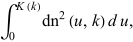 |
(4)
|
where  is an incomplete elliptic
integral of the second kind,
is an incomplete elliptic
integral of the second kind,  is the hypergeometric
function, and
is the hypergeometric
function, and  is a Jacobi
elliptic function.
is a Jacobi
elliptic function.
It is implemented in the Wolfram Language as EllipticE[m],
where  is the parameter.
 can be computed in closed form in terms of
  and the elliptic
alpha function
and the elliptic
alpha function  for special values of
  , where
  is a called an elliptic
integral singular value. Other special values include
is a called an elliptic
integral singular value. Other special values include
 |  |  |
(5)
|
 |  |  |
(6)
|
The complete elliptic integral of the second kind satisfies the Legendre relation
 |
(7)
|
where  and
and  are complete elliptic
integrals of the first and second kinds, respectively, and
are complete elliptic
integrals of the first and second kinds, respectively, and  and
and  are the complementary integrals. The derivative
is
are the complementary integrals. The derivative
is
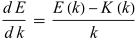 |
(8)
|
(Whittaker and Watson 1990, p. 521).
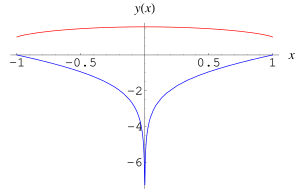
The solution to the differential equation
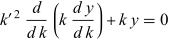 |
(9)
|
(Zwillinger 1997, p. 122; Gradshteyn and Ryzhik 2000, p. 907) is given by
![y=C_1E(k)+C_2[E^'(k)-K^'(k)].](/images/equations/CompleteEllipticIntegraloftheSecondKind/NumberedEquation4.svg) |
(10)
|
If  is a singular value (i.e.,
 |
(11)
|
where  is the elliptic
lambda function), and
is the elliptic
lambda function), and  and the elliptic
alpha function
and the elliptic
alpha function  are also known, then
![E(k)=(K(k))/(sqrt(r))[pi/(3[K(k)]^2)-alpha(r)]+K(k).](/images/equations/CompleteEllipticIntegraloftheSecondKind/NumberedEquation6.svg) |
(12)
|
