


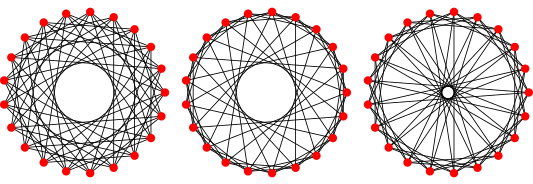
A circulant graph is a graph of  graph vertices in which the
 th graph vertex
is adjacent to the
th graph vertex
is adjacent to the  th
and
th
and  th
graph vertices for each
th
graph vertices for each  in a list
  . The circulant graph
  gives the complete
graph
gives the complete
graph  and the graph
  gives the cyclic graph
  .
.
The circulant graph on  vertices on an offset list
  is implemented in the Wolfram
Language as CirculantGraph[n,
l]. Precomputed properties are available using GraphData[
is implemented in the Wolfram
Language as CirculantGraph[n,
l]. Precomputed properties are available using GraphData[ "Circulant",
  n, l
n, l
 ].
].
With the exception of the degenerate case of the path graph  , connected circulant graphs are biconnected, bridgeless,
cyclic, Hamiltonian,
LCF, regular, traceable, and vertex-transitive.
, connected circulant graphs are biconnected, bridgeless,
cyclic, Hamiltonian,
LCF, regular, traceable, and vertex-transitive.
A graph  is a circulant iff the automorphism
group of
is a circulant iff the automorphism
group of  contains at least one permutation consisting of a
minimal cycle of length
contains at least one permutation consisting of a
minimal cycle of length  .
.
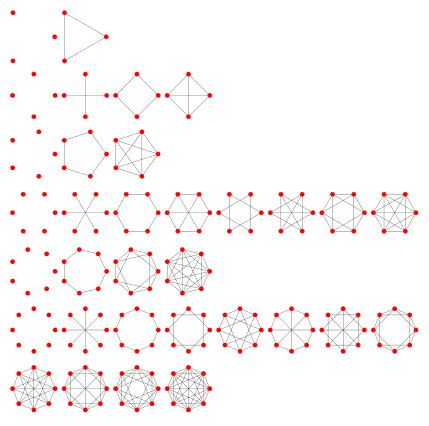
The numbers of circulant graphs on  , 2, ... nodes (counting empty
graphs as circulant graphs) are 1, 2, 2, 4, 3, 8, 4, 12, ... (OEIS A049287),
the first few of which are illustrated above. Note that these numbers cannot be counted
simply by enumerating the number of nonempty subsets of
, 2, ... nodes (counting empty
graphs as circulant graphs) are 1, 2, 2, 4, 3, 8, 4, 12, ... (OEIS A049287),
the first few of which are illustrated above. Note that these numbers cannot be counted
simply by enumerating the number of nonempty subsets of  since, for example,
  . There is an easy formula for prime orders,
and formulas are known for squarefree and prime-squared orders.
. There is an easy formula for prime orders,
and formulas are known for squarefree and prime-squared orders.
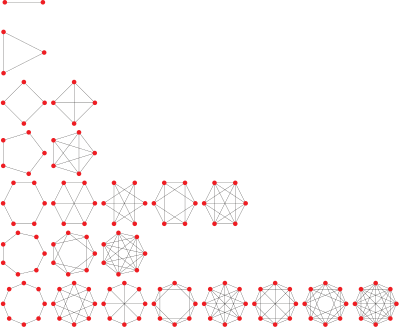
The numbers of connected circulant graphs on  , 2, ... nodes are 0, 1, 1, 2, 2, 5, 3, 8, ..., illustrated
above.
, 2, ... nodes are 0, 1, 1, 2, 2, 5, 3, 8, ..., illustrated
above.
Classes of graphs that are circulant graphs include the Andrásfai graphs, antiprism graphs, cocktail
party graphs  ,
complete graphs, complete
bipartite graphs
,
complete graphs, complete
bipartite graphs  ,
crown graphs
,
crown graphs  , empty graphs, KC
graphs
, empty graphs, KC
graphs  for
for  (i.e.,
  and
and  relatively prime) and where
  denotes a Cartesian
product, rook graphs
denotes a Cartesian
product, rook graphs  for
for  , Möbius ladders,
Paley graphs of prime order, prism
graphs
, Möbius ladders,
Paley graphs of prime order, prism
graphs  ,
and torus grid graphs
,
and torus grid graphs  with
with  corresponding to
  ). Special cases are summarized in the table below.


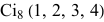


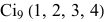







Families of unit-distance connected circulant graphs include:
1. cycle graphs  ,
,
2. Cartesian products of prism graphs  and
and  , yielding torus grid graphs
  .
.
The graph genus is known for all circulant graphs with genus 1 and 2 (Conder and Grande 2015, Metzger and Ulrigg 2025), though while
 appears in the body
of Conder and Grande (2015), it was accidentally omitted from the enumeration of
genus 2 graphs in Theorem 3.
appears in the body
of Conder and Grande (2015), it was accidentally omitted from the enumeration of
genus 2 graphs in Theorem 3.

 and Degree 4 or 5" [Chinese]. Dianzi Keji Daxue Xuebao 25,
272-276, 1996.
and Degree 4 or 5" [Chinese]. Dianzi Keji Daxue Xuebao 25,
272-276, 1996.