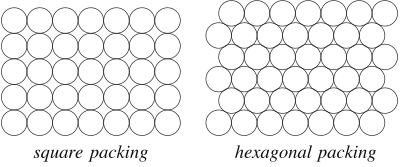
A circle packing is an arrangement of circles inside a given boundary such that no two overlap and some (or all) of them are mutually tangent.
The generalization to spheres is called a sphere
packing. Tessellations of regular polygons correspond
to particular circle packings (Williams 1979, pp. 35-41). There is a well-developed
theory of circle packing in the context of discrete conformal
mapping (Stephenson).
(OEIS A093766; Wells 1986, p. 30). Gauss proved that the hexagonal lattice is the densest
planelattice packing, and in 1940, L. Fejes
Tóth proved that the hexagonal lattice
is indeed the densest of all possible plane packings.
Surprisingly, the circular disk is not the least economical region for packing the plane. The "worst"
packing shape is not known, but among centrally symmetric plane
regions, the conjectured candidate is the so-called smoothed
octagon.
Wells (1991, pp. 30-31) considers the maximum size possible for identical circles packed on the
surface of a unit sphere.
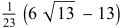
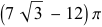
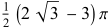
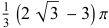
The following table gives the packing densities for the circle packings corresponding to the regular and
semiregular plane tessellations (Williams 1979, p. 49).
tessellation
exact
approx.
0.9069
0.7854
0.6046
0.8418
0.8418
0.6802
0.7773
0.3907
0.5390
0.7290
0.4860
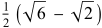
Solutions for the smallest diameter circles into which unit-diameter circles
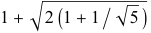
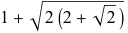
can be packed have been proved optimal for through 10 (Kravitz 1967). The best known results are summarized
in the following table, and the first few cases are illustrated above (Friedman).
exact
approx.
1
1
1.00000
2
2
2.00000
3
2.15470...
4
2.41421...
5
2.70130...
6
3
3.00000
7
3
3.00000
8
3.30476...
9
3.61312...
10
3.82...
11
12
4.02...
The following table gives the diameters of circles giving the densest known
packings of
equal circles packed inside a unit
square, the first few of which are illustrated above (Friedman). All to 20 solutions (in addition to all solutions ) have been proved optimal (Friedman). Peikert (1994) uses
a normalization in which the centers of circles of diameter are packed into a square of side length 1. Friedman lets the
circles have unit radius and gives the smallest square
side length .
A tabulation of analytic and diagrams for to 25 circles is given by Friedman.
Coordinates for optimal packings are given by Nurmela and Östergård (1997).
1
1
1.000000
2
0.585786
1.414214
3
0.508666
1.035276
4
0.500000
1
1.000000
5
0.414214
0.707107
6
0.375361
0.600925
7
0.348915
0.535898
8
0.341081
0.517638
9
0.333333
0.500000
10
0.296408
0.421280
The smallest square into which two unit circles, one of which is split into two pieces by a chord, can be packed is not
known (Goldberg 1968, Ogilvy 1990).
The best known packings of circles into an equilateral
triangle are shown above for the first few cases (Friedman).



 identical circles packed on the
surface of a unit sphere.
identical circles packed on the
surface of a unit sphere.






 for the circle packings corresponding to the regular and
semiregular plane tessellations (Williams 1979, p. 49).
for the circle packings corresponding to the regular and
semiregular plane tessellations (Williams 1979, p. 49).
 exact
exact approx.






 unit-diameter circles
can be packed have been proved optimal for
unit-diameter circles
can be packed have been proved optimal for  through 10 (Kravitz 1967). The best known results are summarized
in the following table, and the first few cases are illustrated above (Friedman).
through 10 (Kravitz 1967). The best known results are summarized
in the following table, and the first few cases are illustrated above (Friedman).

 exact
exact approx.



 of circles giving the densest known
packings of
of circles giving the densest known
packings of  equal circles packed inside a unit
square, the first few of which are illustrated above (Friedman). All
equal circles packed inside a unit
square, the first few of which are illustrated above (Friedman). All  to 20 solutions (in addition to all solutions
  ) have been proved optimal (Friedman). Peikert (1994) uses
a normalization in which the centers of
) have been proved optimal (Friedman). Peikert (1994) uses
a normalization in which the centers of  circles of diameter
  are packed into a square of side length 1. Friedman lets the
circles have unit radius and gives the smallest square
side length
are packed into a square of side length 1. Friedman lets the
circles have unit radius and gives the smallest square
side length  .
A tabulation of analytic
.
A tabulation of analytic  and diagrams for
  to 25 circles is given by Friedman.
Coordinates for optimal packings are given by Nurmela and Östergård (1997).
to 25 circles is given by Friedman.
Coordinates for optimal packings are given by Nurmela and Östergård (1997).