


The word "base" in mathematics has several meanings, generally referring to an object chosen as a reference or building block.
In geometry, a base is a designated side of a plane figure or planar boundary region of a solid, often used as the reference from which an altitude is measured. In two dimensions, any side of a triangle may be chosen as its base, while the parallel sides of a trapezoid are its two bases. In three dimensions, a prism or cylinder has two congruent parallel bases, whereas a pyramid or cone has one base. A base need not be the lowest side or boundary region in a drawing.
In arithmetic, "base" has two closely related uses: the base of a numeral system and the base of a logarithm.
A real number  can be represented using an integer
base
can be represented using an integer
base  with
with  (sometimes also called a radix
or scale). The choice of a base yields a representation of numbers
known as a numeral system. In base
(sometimes also called a radix
or scale). The choice of a base yields a representation of numbers
known as a numeral system. In base  , the digits 0, 1, ...,
  are used (where, by convention, for bases larger than
10, the symbols A, B, C, ... are generally used as symbols representing the decimal numbers 10, 11, 12, ...).
are used (where, by convention, for bases larger than
10, the symbols A, B, C, ... are generally used as symbols representing the decimal numbers 10, 11, 12, ...).
The decimal system uses decimal digits, while binary uses binary digits. Their place values are powers of 10 and 2, respectively.
The digits of a number  in base
  (for integer
  ) can be obtained in the Wolfram
Language using IntegerDigits[x,
b].
) can be obtained in the Wolfram
Language using IntegerDigits[x,
b].
Let the base  representation of a number
  be written
 |
(1)
|
(e.g.,  ). Then, for example, the
number 10 is written in various bases as
). Then, for example, the
number 10 is written in various bases as
 |  |  |
(2)
|
 |  |  |
(3)
|
 |  |  |
(4)
|
 |  |  |
(5)
|
 |  |  |
(6)
|
 |  |  |
(7)
|
 |  |  |
(8)
|
 |  |  |
(9)
|
 |  |  |
(10)
|
 |  |  |
(11)
|
since, for example,
 |  |  |
(12)
|
 |  |  |
(13)
|
 |  |  |
(14)
|
and so on.
Common bases are given special names based on the value of  , as summarized in the following table. The most common bases
are binary and hexadecimal
(used by computers) and decimal (used by people).
, as summarized in the following table. The most common bases
are binary and hexadecimal
(used by computers) and decimal (used by people).
| base | number system |
| 2 | binary |
| 3 | ternary |
| 4 | quaternary |
| 5 | quinary |
| 6 | senary |
| 7 | septenary |
| 8 | octal |
| 9 | nonary |
| 10 | decimal |
| 11 | undenary |
| 12 | duodecimal |
| 16 | hexadecimal |
| 20 | vigesimal |
| 60 | sexagesimal |
The index of the leading digit needed to represent the number is
 |
(15)
|
where  is the floor
function. Now, recursively compute the successive
digits
is the floor
function. Now, recursively compute the successive
digits
 |
(16)
|
where  and
and
 |
(17)
|
for  ,
,  , ..., 1, 0, .... This gives the base
  representation of
  . Note that if
  is an integer, then
  need only run through 0, and that if
  has a fractional part,
then the expansion may or may not terminate. For example, the hexadecimal
representation of 0.1 (which terminates in decimal notation)
is the infinite expression
has a fractional part,
then the expansion may or may not terminate. For example, the hexadecimal
representation of 0.1 (which terminates in decimal notation)
is the infinite expression  .
.
Some numeral systems use a mixture of bases for counting. Examples include the Mayan calendar and the old British monetary system (in which ha'pennies, pennies, threepence, sixpence, shillings, half crowns, pounds, and guineas corresponded to units of 1/2, 1, 3, 6, 12, 30, 240, and 252, respectively).
Bergman (1957/58) considered an irrational base, and Knuth (1998) considered transcendental
bases. This leads to some rather unfamiliar results, such as equating  to 1 in "base
  ,"
,"  .
Even more unexpectedly, the representation of a given integer
in an irrational base may be nonunique, for
example
.
Even more unexpectedly, the representation of a given integer
in an irrational base may be nonunique, for
example
 |  |  |
(18)
|
 |  |  |
(19)
|
where  is the golden
ratio.
is the golden
ratio.
It is also possible to consider negative bases such as negabinary and negadecimal (e.g., Allouche and Shallit 2003). The digits in a negative base may be obtained with the Wolfram Language code
  NegativeIntegerDigits[0, n_Integer?Negative] := {0}
  NegativeIntegerDigits[i_, n_Integer?Negative] :=
    Rest @ Reverse @ Mod[
      NestWhileList[(# - Mod[#, -n])/n& ,
        i, # != 0& ],
    -n]
The base of a logarithm is a number  used to define the numeral
system in which the logarithm is computed. In general,
the logarithm of a number
used to define the numeral
system in which the logarithm is computed. In general,
the logarithm of a number  in base
  is written
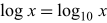
  . The symbol
  is an abbreviation regrettably used both for the common
logarithm
is an abbreviation regrettably used both for the common
logarithm  (by engineers and physicists and indicated on pocket calculators) and for the natural logarithm
  (by mathematicians).
  denotes the natural logarithm
  (as used by engineers and physicists
and indicated on pocket calculators), and
(as used by engineers and physicists
and indicated on pocket calculators), and  denotes
  .
In this work, the notations
.
In this work, the notations  and
and  are used.
To convert between logarithms in different bases, the formula
 |
(20)
|
can be used.
