

The de Bruijn-Newman constant  is the real number such
that the function
is the real number such
that the function  defined below has only real
zeros if and only if
defined below has only real
zeros if and only if  . Let
. Let  be the xi-function defined
by
be the xi-function defined
by
 |
(1)
|
 can be viewed as the Fourier transform of the
signal
can be viewed as the Fourier transform of the
signal
 |
(2)
|
for  ,
,
 .
Then denote the Fourier transform of
.
Then denote the Fourier transform of  as
as  ,
,
=H(lambda,z).](/images/equations/deBruijn-NewmanConstant/NumberedEquation3.svg) |
(3)
|
Newman (1976) proved that such a constant exists and conjectured that  . The Riemann
hypothesis is equivalent to the conjecture that
. The Riemann
hypothesis is equivalent to the conjecture that  , so Newman's conjecture asserts that the Riemann
hypothesis, if true, is only barely true. The following table summarizes best
known lower bounds on
, so Newman's conjecture asserts that the Riemann
hypothesis, if true, is only barely true. The following table summarizes best
known lower bounds on  prior to 2020, when Rodgers and Tao (2020) proved that
 .
.
| lower bound | reference |
 | Newman (1976) |
 | Csordas-Norfolk-Varga (1988) |
 | te Riele (1991) |
 | Norfolk-Ruttan-Varga (1992) |
 | Csordas-Ruttan-Varga (1991) |
 | Csordas-Smith-Varga (1994) |
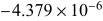 | Csordas-Odlyzko-Smith-Varga (1993) |
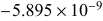 | Odlyzko (2000) |
 | Saouter-Gourdon-Demichel (2011) |
Upper bounds on 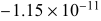 are summarized below. The final three rows are computer-assisted
bounds reported in 2026 that had not undergone external peer review as of Sep. 15,
2026.
are summarized below. The final three rows are computer-assisted
bounds reported in 2026 that had not undergone external peer review as of Sep. 15,
2026.
| upper bound | reference | status |
 | de Bruijn (1950) | published |
 | Ki-Kim-Lee (2009) | published |
 | Polymath (2019) | published |
 | Platt-Trudgian (2021) | published |
 | Mosaic Intelligence (2026) | unreviewed |
 | Gomila (2026) | unreviewed |
 | Gordon (2026) | unreviewed |
Mosaic Intelligence (2026) describes its bound as AI-generated. Gomila (2026) reports human-directed work using Claude and ChatGPT/Codex, while Gordon (2026) reports assistance from GPT-6 Astra and Claude Code. The Mosaic Intelligence and Gomila projects provide numerical certificates. Gordon's partial Lean formalization is conditional on stated analytic inputs.

 ." Numer. Math. 52, 483-497, 1988.Csordas,
G.; Odlyzko, A.; Smith, W.; and Varga, R. S. "A New Lehmer Pair of Zeros
and a New Lower Bound for the de Bruijn-Newman Constant." Elec. Trans. Numer.
Analysis 1, 104-111, 1993.Csordas, G.; Ruttan, A.; and Varga,
R. S. "The Laguerre Inequalities with Applications to a Problem Associated
with the Riemann Hypothesis." Numer. Algorithms 1, 305-329, 1991.Csordas,
G.; Smith, W.; and Varga, R. S. "Lehmer Pairs of Zeros, the de Bruijn-Newman
Constant and the Riemann Hypothesis." Constr. Approx. 10, 107-129,
1994.de Bruijn, N. G. "The Roots of Trigonometric Integrals."
Duke Math. J. 17, 197-226, 1950.Finch, S. R. "De
Bruijn-Newman Constant." §2.3 2 in
." Numer. Math. 52, 483-497, 1988.Csordas,
G.; Odlyzko, A.; Smith, W.; and Varga, R. S. "A New Lehmer Pair of Zeros
and a New Lower Bound for the de Bruijn-Newman Constant." Elec. Trans. Numer.
Analysis 1, 104-111, 1993.Csordas, G.; Ruttan, A.; and Varga,
R. S. "The Laguerre Inequalities with Applications to a Problem Associated
with the Riemann Hypothesis." Numer. Algorithms 1, 305-329, 1991.Csordas,
G.; Smith, W.; and Varga, R. S. "Lehmer Pairs of Zeros, the de Bruijn-Newman
Constant and the Riemann Hypothesis." Constr. Approx. 10, 107-129,
1994.de Bruijn, N. G. "The Roots of Trigonometric Integrals."
Duke Math. J. 17, 197-226, 1950.Finch, S. R. "De
Bruijn-Newman Constant." §2.3 2 in  for the de Bruijn-Newman
Constant." Aug. 20, 2026.
for the de Bruijn-Newman
Constant." Aug. 20, 2026.  for the de Bruijn-Newman Constant." Jul. 3,
2026.
for the de Bruijn-Newman Constant." Jul. 3,
2026.  II." In Progress in Approximation Theory
(Ed. A. A. Gonchar and E. B. Saff). New York: Springer, pp. 403-418,
1992.Odlyzko, A. M. "An Improved Bound for the De Bruijn-Newman
Constant." Numer. Algorithms 25, 293-303, 2000.Platt,
D. and Trudgian, T. "The Riemann Hypothesis Is True up to
II." In Progress in Approximation Theory
(Ed. A. A. Gonchar and E. B. Saff). New York: Springer, pp. 403-418,
1992.Odlyzko, A. M. "An Improved Bound for the De Bruijn-Newman
Constant." Numer. Algorithms 25, 293-303, 2000.Platt,
D. and Trudgian, T. "The Riemann Hypothesis Is True up to  ." Bull. London Math. Soc. 53,
792-797, 2021.
." Bull. London Math. Soc. 53,
792-797, 2021.