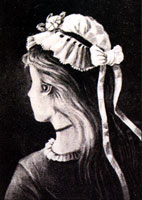
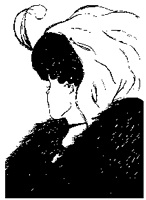
Young Girl-Old Woman Illusion
A famous perceptual illusion in which the brain switches between seeing a young girl and an old woman (or "wife" and "mother
in law"). An anonymous German postcard from 1888 (left figure) depicts the image
in its earliest known form, and a rendition on an advertisement for the Anchor Buggy
Company from 1890 (center figure) provides another early example (IllusionWorks).
For many years, the creator of this figure was thought to be British cartoonist W. E. Hill,
who published it in 1915 in Puck humor magazine, an American magazine inspired
by the British magazine Punch (right figure). However, Hill almost certainly
adapted the figure from an original concept that was popular throughout the world
on trading and puzzle cards.
SEE ALSO: Illusion,
Rabbit-Duck
Illusion
REFERENCES:
Boring, E. G. "A New Ambiguous Figure." Amer. J. Psychology 42,
444, 1930.
Botwinick, J. "Husband and Father-in-Law: A Reversible Figure." Amer.
J. Psychology 74, 312-113, 1961.
Fisher, G. "Mother, Father, and Daughter: A Three-Aspect Ambiguous Figure."
Amer. J. Psychology 81, 274-277.1968.
Hill, W. E. "My Wife and My Mother-in-Law." Puck 16,
11, Nov. 1915.
Kid's World. "Optical Illusions--2." http://www.frontiernet.net/~docbob/ilusion2.htm.
IllusionWorks. "Perceptual Ambiguity." http://psylux.psych.tu-dresden.de/i1/kaw/diverses%20Material/www.illusionworks.com/html/perceptual_ambiguity.html.
Pappas, T. The Joy of Mathematics. San Carlos, CA: Wide World Publ./Tetra, p. 173,
1989.
Seckel, A. The
Art of Optical Illusions. Carlton Books, p. 89, 2002.
Van den Berg, S. "Ambiguous People." http://members.lycos.nl/amazingart/E/12.html.
Wright, E. "The Original of E. G. Boring's Young Girl/Mother-in-Law Drawing and Its Relation to the Pattern of a Joke." Perception 21,
273-275, 1992.
Referenced on Wolfram|Alpha:
Young Girl-Old Woman Illusion
CITE THIS AS:
Weisstein, Eric W. "Young Girl-Old Woman Illusion."
From MathWorld--A Wolfram Web Resource. http://mathworld.wolfram.com/YoungGirl-OldWomanIllusion.html