The quadratic reciprocity theorem states that if and are distinct oddprimes,
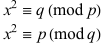
then the congruences
(1)
are both solvable or both unsolvable unless both and leave the remainder 3 when divided by 4 (in which case one
of the congruences is solvable and the other is not).
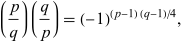
Written symbolically,
Gauss called this result the "aureum theorema" (golden theorem).
Euler stated the theorem in 1783 without proof. Legendre was the first to publish a proof, but it was fallacious. In 1796, Gauss became the first to publish a correct
proof (Nagell 1951, p. 144). The quadratic reciprocity theorem was Gauss's favorite
theorem from number theory, and he devised no fewer
than eight different proofs of it over his lifetime.


 and
and  are distinct odd primes,
then the congruences
are distinct odd primes,
then the congruences
 and
and  leave the remainder 3 when divided by 4 (in which case one
of the congruences is solvable and the other is not).
Written symbolically,
leave the remainder 3 when divided by 4 (in which case one
of the congruences is solvable and the other is not).
Written symbolically,


 a
a  or
or  .
.
