Prince Rupert's cube is the largest cube that can be made to pass through a given cube. In other words, the cube
having a side length equal to the side length of the largest hole
of a squarecross section
that can be cut through a unit cube without splitting it
into two pieces.
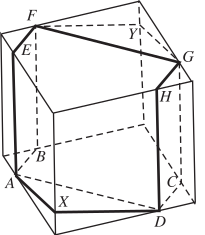
Prince Rupert's cube cuts a hole of the shape indicated in the above illustration (Wells 1991). Curiously, it is slightly larger than the
original cube, with side length (OEIS A093577).
Any cube this size or smaller can be made to pass through
the original cube.
Croft, H. T.; Falconer, K. J.; and Guy, R. K. "Prince Rupert's Problem." §B4 in Unsolved
Problems in Geometry. New York: Springer-Verlag, pp. 53-54, 1991.Cundy,
H. and Rollett, A. "Prince Rupert's Cubes." §3.15.2 in Mathematical
Models, 3rd ed. Stradbroke, England: Tarquin Pub., pp. 157-158, 1989.Schrek,
D. J. E. "Prince Rupert's Problem and Its Extension by Pieter Nieuwland."
Scripta Math.16, 73-80 and 261-267, 1950.Sloane, N. J. A.
Sequence A093577 in "The On-Line Encyclopedia
of Integer Sequences."Wells, D. The
Penguin Dictionary of Curious and Interesting Numbers. Middlesex, England:
Penguin Books, p. 33, 1986.Wells, D. The
Penguin Dictionary of Curious and Interesting Geometry. London, England:
Penguin, p. 195, 1991.


 (OEIS A093577).
Any cube this size or smaller can be made to pass through
the original cube.
(OEIS A093577).
Any cube this size or smaller can be made to pass through
the original cube.
