Borwein, J. and Bailey, D. Mathematics by Experiment: Plausible Reasoning in the 21st Century. Wellesley, MA: A
K Peters, 2003.Domb, C. "On Multiple Returns in the Random-Walk
Problem." Proc. Cambridge Philos. Soc.50, 586-591, 1954.Finch,
S. R. "Pólya's Random Walk Constant." §5.9 in Mathematical
Constants. Cambridge, England: Cambridge University Press, pp. 322-331,
2003.Glasser, M. L. and Zucker, I. J. "Extended Watson
Integrals for the Cubic Lattices." Proc. Nat. Acad. Sci. U.S.A.74,
1800-1801, 1977.McCrea, W. H. and Whipple, F. J. W. "Random
Paths in Two and Three Dimensions." Proc. Roy. Soc. Edinburgh60,
281-298, 1940.Montroll, E. W. "Random Walks in Multidimensional
Spaces, Especially on Periodic Lattices." J. SIAM4, 241-260,
1956.Sloane, N. J. A. Sequences A086230,
A086231, A086232,
A086233, A086234,
A086235, and A086236
in "The On-Line Encyclopedia of Integer Sequences."Watson,
G. N. "Three Triple Integrals." Quart. J. Math., Oxford Ser. 210,
266-276, 1939.


 be the probability that a random walk on a
  -D lattice returns to the origin. In 1921, Pólya proved
that
-D lattice returns to the origin. In 1921, Pólya proved
that


 .
Watson (1939), McCrea and Whipple (1940), Domb (1954), and Glasser and Zucker (1977)
showed that
.
Watson (1939), McCrea and Whipple (1940), Domb (1954), and Glasser and Zucker (1977)
showed that






![(12)/(pi^2)(18+12sqrt(2)-10sqrt(3)-7sqrt(6)){K[(2-sqrt(3))(sqrt(3)-sqrt(2))]}^2](/images/equations/PolyasRandomWalkConstants/Inline9.svg)


![3(18+12sqrt(2)-10sqrt(3)-7sqrt(6))[1+2sum_(k=1)^(infty)exp(-k^2pisqrt(6))]^4](/images/equations/PolyasRandomWalkConstants/Inline12.svg)





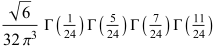



 is a complete
elliptic integral of the first kind,
is a complete
elliptic integral of the first kind,  is a Jacobi
theta function, and
is a Jacobi
theta function, and  is the gamma function.
 are not known, but Montroll (1956) showed that for
  ,
,
![p(d)=1-[u(d)]^(-1),](/images/equations/PolyasRandomWalkConstants/NumberedEquation4.svg)





![int_0^infty[I_0(t/d)]^de^(-t)dt,](/images/equations/PolyasRandomWalkConstants/Inline32.svg)
 is a modified Bessel function
of the first kind.
is a modified Bessel function
of the first kind.
 from Montroll (1956) and Flajolet (Finch 2003) are given
in the following table.
from Montroll (1956) and Flajolet (Finch 2003) are given
in the following table.


