A plane partition is a two-dimensional array of integers that are nonincreasing both from
left to right and top to bottom and that add up to a given number . In other words,
(1)
(2)
and
(3)
Implicit in this definition is the requirement that the array be flush on top and to the left and contain no holes.
(4)
For example, one plane partition of 22 is illustrated above.
MacMahon (1960) also showed that the number of plane partitions whose Young
tableaux fit inside an rectangle and whose integers do not exceed (in other words, with all ) is given by
(8)
(Bressoud and Propp 1999, Fulmek and Krattenthaler 2000). Expanding out the products gives
the first few terms of which are 2, 20, 980, 232848, 267227532, 1478619421136, ... (OEIS A008793). Amazingly, also gives the number of hexagon
tilings by rhombi for a hexagon of side lengths , , , , , (David and Tomei 1989, Fulmek and Krattenthaler 2000).
The concept of planar partitions can also be generalized to cubic partitions.
Bender, E. A. and Knuth, D. E. "Enumeration of Plane Partitions." J. Combin. Theory Ser. A.13, 40-54, 1972.Bressoud,
D. Proofs
and Confirmations: The Story of the Alternating Sign Matrix Conjecture. Cambridge,
England: Cambridge University Press, 1999.Bressoud, D. and Propp, J.
"How the Alternating Sign Matrix Conjecture Was Solved." Not. Amer.
Math. Soc.46, 637-646.Cohn, H.; Larsen, M.; and Propp, J.
"The Shape of a Typical Boxed Plane Partition." New York J. Math.4,
137-166, 1998.David, G. and Tomei, C. "The Problem of the Calissons."
Amer. Math. Monthly96, 429-431, 1989.Fulmek, M. and Krattenthaler,
C. "The Number of Rhombus Tilings of a Symmetric Hexagon Which Contains a Fixed
Rhombus on the Symmetry Axes, II." Europ. J. Combin.21, 601-640,
2000.Knuth, D. E. "A Note on Solid Partitions." Math.
Comput.24, 955-961, 1970.MacMahon, P. A. "Memoir
on the Theory of the Partitions of Numbers. V: Partitions in Two-Dimensional Space."
Phil. Trans. Roy. Soc. London Ser. A211, 75-110, 1912a.MacMahon,
P. A. "Memoir on the Theory of the Partitions of Numbers. VI: Partitions
in Two-Dimensional Space, to Which Is Added an Adumbration of the Theory of Partitions
in Three-Dimensional Space." Phil. Trans. Roy. Soc. London Ser. A211,
345-373, 1912b.MacMahon, P. A. §429 and 494 in Combinatory
Analysis, Vol. 2. New York: Chelsea, 1960.Mills, W. H.;
Robbins, D. P.; and Rumsey, H. Jr. "Proof of the Macdonald Conjecture."
Invent. Math.66, 73-87, 1982.Sloane, N. J. A.
Sequences A000219/M2566 and A008793
in "The On-Line Encyclopedia of Integer Sequences."Speciner,
M. Item 18 in Beeler, M.; Gosper, R. W.; and Schroeppel, R. HAKMEM. Cambridge,
MA: MIT Artificial Intelligence Laboratory, Memo AIM-239, p. 10, Feb. 1972.
https://www.inwap.com/pdp10/hbaker/hakmem/boolean.html#item18.Stanley,
R. P. "Symmetry of Plane Partitions." J. Combin. Th. Ser. A3,
103-113, 1986.Stanley, R. P. "A Baker's Dozen of Conjectures
Concerning Plane Partitions." In Combinatoire
Énumérative: Proceedings of the "Colloque De Combinatoire Enumerative,"
Held at Université Du Quebec a Montreal, May 28-June 1, 1985 (Ed.
G. Labelle and P. Leroux). New York: Springer-Verlag, 285-293, 1986.


 that are nonincreasing both from
left to right and top to bottom and that add up to a given number
that are nonincreasing both from
left to right and top to bottom and that add up to a given number  . In other words,


 of planar partitions of
  is
is

 ,
a recurrence equation for
,
a recurrence equation for  is given by
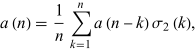
 is a divisor function. It also has generating
function
is a divisor function. It also has generating
function
![G(x)=exp[sum_(n=1)^inftysigma_2(n)(x^n)/n].](/images/equations/PlanePartition/NumberedEquation7.svg)
 of plane partitions whose Young
tableaux fit inside an
of plane partitions whose Young
tableaux fit inside an  rectangle and whose integers do not exceed
  (in other words, with all
  ) is given by
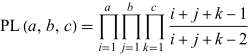


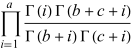



 is the Barnes G-function. Taking
  gives
gives


![product_(i=1)^(n)(Gamma(i)Gamma(i+2n))/([Gamma(i+n)]^2)](/images/equations/PlanePartition/Inline22.svg)


![([G(n+1)]^3G(3n+1))/([G(2n+1)]^3),](/images/equations/PlanePartition/Inline25.svg)
 also gives the number of hexagon
tilings by rhombi for a hexagon of side lengths
also gives the number of hexagon
tilings by rhombi for a hexagon of side lengths  ,
,  ,
,  ,
,  ,
,  ,
,  (David and Tomei 1989, Fulmek and Krattenthaler 2000).
