Let
be a permutation. Then is a permutation ascent if . For example, the permutation is composed of three ascents, namely , , and .
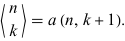
The number of permutations of length having ascents is given by the Eulerian
number.
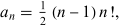
The total number of ascents in all permutations of order is
giving the first few terms for , 2, ... as 0, 1, 6, 36, 240, 1800, 15120, ... (OEIS A001286).
There is an intimate connection between permutation ascents and permutation runs, with the number of ascents of length in the permutations being equal to the number of permutation
runs
of length
(Skiena 1990, p. 31), or


 be a permutation. Then
  is a permutation ascent if
  . For example, the permutation
  is composed of three ascents, namely
  ,
,  , and
, and  .
.
 having
  ascents is given by the Eulerian
number
ascents is given by the Eulerian
number  .
.
 is
is
 , 2, ... as 0, 1, 6, 36, 240, 1800, 15120, ... (OEIS A001286).
 in the permutations
  being equal to the number of permutation
runs
being equal to the number of permutation
runs  of length
  (Skiena 1990, p. 31), or