


A perfect power is a positive integer  of the form
  , where
  is a positive integer
and
is a positive integer
and  is an integer.
This convention includes 1. For
is an integer.
This convention includes 1. For  , if the prime factorization
of
, if the prime factorization
of  is
is  , then
  is a perfect power iff
  .
.
Each representation  expresses a perfect power as an even power or an odd power according as
  is even or odd.
Some perfect powers, such as
is even or odd.
Some perfect powers, such as  , are both.
Including duplications (i.e., taking all numbers up to some cutoff and taking all their powers) and taking  ,
the first few are 4, 8, 9, 16, 16, 25, 27, 32, 36, 49, 64, 64, 64, ... (OEIS A072103).
Here, 16 is duplicated since
,
the first few are 4, 8, 9, 16, 16, 25, 27, 32, 36, 49, 64, 64, 64, ... (OEIS A072103).
Here, 16 is duplicated since
 |
(1)
|
The sum of reciprocals of perfect powers (excluding 1) with duplications converges,
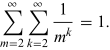 |
(2)
|
The first few numbers that are perfect powers in more than one way are 16, 64, 81, 256, 512, 625, 729, 1024, 1296, 2401, 4096, ... (OEIS A117453).
The first few perfect powers without duplications are 1, 4, 8, 9, 16, 25, 27, 32, 36, 49, 64, 81, 100, 121, 125, ... (OEIS A001597). Even more amazingly, the sum of the reciprocals of these numbers (excluding 1) is given by
![sum_(k=2)^inftymu(k)[1-zeta(k)] approx 0.874464368...](/images/equations/PerfectPower/NumberedEquation3.svg) |
(3)
|
(OEIS A072102), where  is the Möbius function
and
is the Möbius function
and  is the Riemann zeta function.
The numbers of perfect powers without duplications not exceeding 10,  ,
,  , ... are 4, 13, 41, 125, 367, ... (OEIS A070428).
