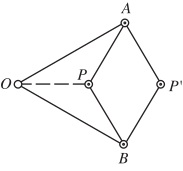
A linkage with six rods which draws the inverse of a given curve. When a pencil is placed at , the inverse is drawn at (or vice versa). If a seventh rod (dashed) is added (with
an additional pivot), is kept on a circle and the locus traced out by is a straight line. It therefore converts circular motion
to linear motion without sliding, and was discovered in 1864. Another linkage
which performs this feat using hinged squares had been published by Sarrus in 1853
but ignored. Coxeter (1969, p. 428) shows that


 , the inverse is drawn at
  (or vice versa). If a seventh rod (dashed) is added (with
an additional pivot),
(or vice versa). If a seventh rod (dashed) is added (with
an additional pivot),  is kept on a circle and the locus traced out by
  is a straight line. It therefore converts circular motion
to linear motion without sliding, and was discovered in 1864. Another linkage
which performs this feat using hinged squares had been published by Sarrus in 1853
but ignored. Coxeter (1969, p. 428) shows that
is a straight line. It therefore converts circular motion
to linear motion without sliding, and was discovered in 1864. Another linkage
which performs this feat using hinged squares had been published by Sarrus in 1853
but ignored. Coxeter (1969, p. 428) shows that

