

In a normal  Latin square, the entries in each row and column are
chosen from a "global" set of
Latin square, the entries in each row and column are
chosen from a "global" set of  objects. Like a Latin square,
a partial Latin square has no two rows or columns which contain the same two symbols.
However, in a partial Latin square, each cell is assigned one of its own set of
objects. Like a Latin square,
a partial Latin square has no two rows or columns which contain the same two symbols.
However, in a partial Latin square, each cell is assigned one of its own set of  possible "local" (and distinct)
symbols, chosen from an overall set of more than three distinct symbols, and these
symbols may vary from location to location. For example, given the possible symbols
possible "local" (and distinct)
symbols, chosen from an overall set of more than three distinct symbols, and these
symbols may vary from location to location. For example, given the possible symbols
 which must be arranged as
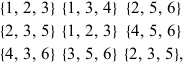 |
the  partial Latin square
 |
can be constructed.
