A partial derangment is a permutation of distinct, ordered items in which none of the items is in its
original ordered position is known as a derangement.
If some, but not necessarily all, of the items are not in their original ordered
positions, the configuration can be referred to as a partial derangement (Evans et
al. 2002, p. 385).
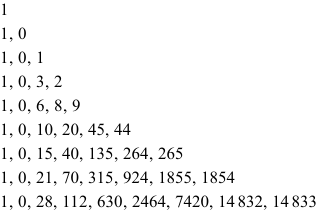
Among the
possible permutations of distinct items, examine the number of these permutations in which exactly items are in their original ordered positions. Then
Finding a partial derangement is sometimes known as the recontres problem, and the numbers in a triangle of numbers in a partial derangeament are called recontres numbers.
Evans, C. D. H.; Hughes, J.; and Houston, J. "Significance-Testing the Validity of Idiographic Methods: A Little Derangement Goes a Long Way."
Brit. J. Math. Stat. Psych.55, 385-390, 2002.Pitman,
J. "Some Probabilistic Aspects of Set Partitions." Amer. Math. Monthly104,
201-209, 1997.Riordan, J. An
Introduction to Combinatorial Analysis. New York: Wiley, pp. 57-58 and
65, 1980.Skiena, S. "Derangements." §1.4.2 in Implementing
Discrete Mathematics: Combinatorics and Graph Theory with Mathematica. Reading,
MA: Addison-Wesley, pp. 33-34, 1990.Sloane, N. J. A.
Sequence A098825 in "The On-Line Encyclopedia
of Integer Sequences."


 distinct, ordered items in which none of the items is in its
original ordered position is known as a derangement.
If some, but not necessarily all, of the items are not in their original ordered
positions, the configuration can be referred to as a partial derangement (Evans et
al. 2002, p. 385).
distinct, ordered items in which none of the items is in its
original ordered position is known as a derangement.
If some, but not necessarily all, of the items are not in their original ordered
positions, the configuration can be referred to as a partial derangement (Evans et
al. 2002, p. 385).
 possible permutations of
  distinct items, examine the number
  of these permutations in which exactly
  items are in their original ordered positions. Then


 is a binomial coefficient and
  is the subfactorial
 for
for  , 1, ..., 8: