made with Mathematica technology MathWorld

Parallel Lines
Parallel

Two lines in two-dimensional Euclidean space are said to be parallel if they do not intersect.

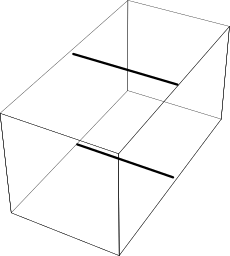
In three-dimensional Euclidean space, parallel lines not only fail to intersect, but also maintain a constant separation between points closest to each other on the two lines. Therefore, parallel lines in three-space lie in a single plane (Kern and Blank 1948, p. 9). Lines in three-space which are not parallel but do not intersect are called skew lines.

Two trilinear lines

lalpha+mbeta+ngamma=0
(1)
l^'alpha+m^'beta+n^'gamma=0
(2)

are parallel if

 |a b c; l m n; l^' m^' n^'|=0
(3)

(Kimberling 1998, p. 29).

SEE ALSO: Café Wall Illusion, Coplanar, Intersecting Lines, Parallel, Parallel Curves, Parallel Line and Plane, Parallel Planes, Parallel Postulate, Perpendicular, Ponzo's Illusion, Proclus' Axiom, Skew Lines, Zöllner's Illusion

REFERENCES:

Kern, W. F. and Bland, J. R. Solid Mensuration with Proofs, 2nd ed. New York: Wiley, p. 9, 1948.

Kimberling, C. "Triangle Centers and Central Triangles." Congr. Numer. 129, 1-295, 1998.


CITE THIS AS:

Weisstein, Eric W. "Parallel Lines." From MathWorld--A Wolfram Web Resource. http://mathworld.wolfram.com/ParallelLines.html

Wear Your Math Proudly!