

A number which is simultaneously octagonal and triangular. Let  denote the
  th octagonal number and
 the
the  th
triangular number, then a number which is both
octagonal and triangular satisfies the equation
th
triangular number, then a number which is both
octagonal and triangular satisfies the equation  , or
, or
 |
(1)
|
Completing the square and rearranging gives
 |
(2)
|
Therefore, defining
 |  |  |
(3)
|
 |  |  |
(4)
|
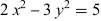
gives the second-order Diophantine equation
 |
(5)
|
The first few solutions are  , (4, 3), (16, 13), (38, 31), (158, 129), (376, 307),
.... These give the solutions
, (4, 3), (16, 13), (38, 31), (158, 129), (376, 307),
.... These give the solutions  , (1, 1), (3, 6), (20/3, 15), (80/3, 64), (63,
153), ..., of which the integer solutions are (1, 1), (3, 6), (63, 153), (261, 638),
(6141, 15041), (25543, 62566), (601723, 1473913), ... (OEIS A046181
and A046182), corresponding to the octagonal
triangular numbers 1, 21, 11781, 203841, 113123361, ... (OEIS A046183).
, (1, 1), (3, 6), (20/3, 15), (80/3, 64), (63,
153), ..., of which the integer solutions are (1, 1), (3, 6), (63, 153), (261, 638),
(6141, 15041), (25543, 62566), (601723, 1473913), ... (OEIS A046181
and A046182), corresponding to the octagonal
triangular numbers 1, 21, 11781, 203841, 113123361, ... (OEIS A046183).
