


An oblate spheroid is a "squashed" spheroid for which the equatorial radius  is greater than the polar radius
  , so
, so  (called an oblate ellipsoid by Tietze 1965, p. 27).
An oblate spheroid is a surface of revolution
obtained by rotating an ellipse about its minor axis
(Hilbert and Cohn-Vossen 1999, p. 10). To first approximation, the shape assumed
by a rotating fluid (including the Earth, which is "fluid" over astronomical
time scales) is an oblate spheroid.
(called an oblate ellipsoid by Tietze 1965, p. 27).
An oblate spheroid is a surface of revolution
obtained by rotating an ellipse about its minor axis
(Hilbert and Cohn-Vossen 1999, p. 10). To first approximation, the shape assumed
by a rotating fluid (including the Earth, which is "fluid" over astronomical
time scales) is an oblate spheroid.
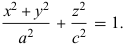
For a spheroid with z-axis as the symmetry axis, the Cartesian equation is
 |
(1)
|
The eccentricity of an oblate spheroid is defined by
 |
(2)
|
The surface area of an oblate spheroid can be computed as a surface of revolution about the z-axis,
![S=2piintr(z)sqrt(1+[r^'(z)]^2)dz](/images/equations/OblateSpheroid/NumberedEquation3.svg) |
(3)
|
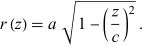
with radius as a function of  given by
 |
(4)
|
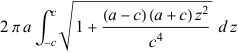
Therefore
 |  |  |
(5)
|
 |  | ![2pia[a+(c^2csch^(-1)(c/(sqrt(a^2-c^2))))/(sqrt(a^2-c^2))]](/images/equations/OblateSpheroid/Inline10.svg) |
(6)
|
 |  | ![(2pi)/(sqrt(a^2-c^2))[a^2sqrt(a^2-c^2)+ac^2ln((a+sqrt(a^2-c^2))/c)]](/images/equations/OblateSpheroid/Inline13.svg) |
(7)
|
 |  | ![pi/(sqrt(a^2-c^2))[2a^2sqrt(a^2-c^2)+ac^2ln((a+sqrt(a^2-c^2))/(a-sqrt(a^2-c^2)))],](/images/equations/OblateSpheroid/Inline16.svg) |
(8)
|
where the last step makes use of the logarithm identity
 |
(9)
|
valid for  .
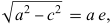
Re-expressing in terms of the eccentricity then
gives
.
Re-expressing in terms of the eccentricity then
gives
 |
(10)
|
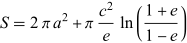
yielding the particular simple form
 |
(11)
|
(Beyer 1987, p. 131). Another equivalent form is given by
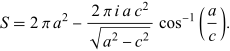 |
(12)
|
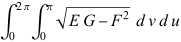
The surface area can also be computed directly from the coefficients of the first fundamental form as
 |  |  |
(13)
|
 |  |  |
(14)
|
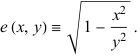
Note that this is the conventional form in which the surface area of an oblate spheroid is written, although it is formally equivalent to the conventional form for the prolate spheroid via the identity
![(c^2pi)/(e(c,a))ln[(1+e(c,a))/(1-e(c,a))]=(2piac)/(e(a,c))sin^(-1)[e(a,c)],](/images/equations/OblateSpheroid/NumberedEquation9.svg) |
(15)
|
where  is defined by
 |
(16)
|
