made with Mathematica technology MathWorld

Nonagon
DOWNLOAD Mathematica Notebook
Nonagon

The nonagon, also known as an enneagon, is a 9-sided polygon. Although the term "enneagon" is perhaps preferable (since it uses the Greek prefix and suffix instead of the mixed Roman/Greek nonagon), the term "nonagon," which is simpler to spell and pronounce, is used in this work.

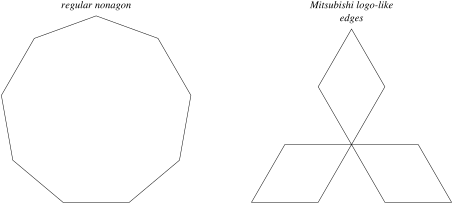
The regular polygon with nine sides and Schläfli symbol {9}.

The (regular) nonagon cannot be constructed using the classical Greek rules of geometric construction, but Conway and Guy (1996) give a Neusis construction based on angle trisection. Madachy (1979) illustrates how to construct a nonagon by folding and knotting a strip of paper. Although the regular nonagon is not a constructible polygon, Dixon (1991) gives constructions for several angles which are close approximations to the nonagonal angle 360 degrees/9=2pi/9, including angles of tan^(-1)(5/6) approx 39.805571 degrees and 2tan^(-1)((sqrt(3)-1)/2) approx 40.207819 degrees.

NonagonAngle

Given a regular nonagon, let M_(AB) be the midpoint of one side, X_(BC) be the mid-arc point of the arc connecting an adjacent side, and M_(OX) the midpoint of OX_(BC). Then, amazingly, ∠OM_(AB)M_(OX)=30 degrees (Karst, quoted in Bankoff and Garfunkel 1973).

SEE ALSO: Nonagram, Polygon, Regular Polygon, Trigonometry Angles--Pi/9

REFERENCES:

Bankoff, L. and Garfunkel, J. "The Heptagonal Triangle." Math. Mag. 46, 7-19, 1973.

Bold, B. Famous Problems of Geometry and How to Solve Them. New York: Dover, pp. 60-61, 1982.

Conway, J. H. and Guy, R. K. The Book of Numbers. New York: Springer-Verlag, pp. 194-200, 1996.

Dixon, R. Mathographics. New York: Dover, pp. 40-44, 1991.

Madachy, J. S. Madachy's Mathematical Recreations. New York: Dover, pp. 60-61, 1979.


CITE THIS AS:

Weisstein, Eric W. "Nonagon." From MathWorld--A Wolfram Web Resource. http://mathworld.wolfram.com/Nonagon.html

The Wolfram Demonstrations Project Browse Topics View Latest
JUST RELEASED: Wolfram Mathematica 7
