Newton's forward difference formula is a finite difference identity giving an interpolated value between tabulated points
in terms of the first value and the powers of the forward
difference. For , the formula states
(1)
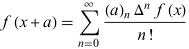
When written in the form
(2)
with
the falling factorial, the formula looks suspiciously
like a finite analog of a Taylor series expansion.
This correspondence was one of the motivating forces for the development of umbral
calculus.
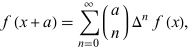
An alternate form of this equation using binomial coefficients is


 in terms of the first value
  and the powers of the forward
difference
and the powers of the forward
difference  . For
. For ![a in [0,1]](/images/equations/NewtonsForwardDifferenceFormula/Inline4.svg) , the formula states
, the formula states

 the falling factorial, the formula looks suspiciously
like a finite analog of a Taylor series expansion.
This correspondence was one of the motivating forces for the development of umbral
calculus.
the falling factorial, the formula looks suspiciously
like a finite analog of a Taylor series expansion.
This correspondence was one of the motivating forces for the development of umbral
calculus.
 represents a polynomial of degree
  in
in  .
.
