


The natural logarithm of 2 is a transcendental quantity that arises often in decay problems, especially when half-lives are being
converted to decay constants.  has numerical value
 |
(1)
|
(OEIS A002162).
The irrationality measure of  is known to be less than 3.8913998 (Rukhadze 1987, Hata
1990).
is known to be less than 3.8913998 (Rukhadze 1987, Hata
1990).
It is not known if  is normal (Bailey and Crandall 2002).
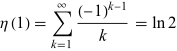
The alternating series and BBP-type formula
 |
(2)
|
converges to the natural logarithm of 2, where  is the Dirichlet
eta function. This identity follows immediately from setting
is the Dirichlet
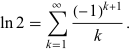
eta function. This identity follows immediately from setting  in the Mercator series,
yielding
in the Mercator series,
yielding
 |
(3)
|
It is also a special case of the identity
 |
(4)
|
where  is the Lerch transcendent.
This is the simplest in an infinite class of such identities, the first few of which are
 |  |  |
(5)
|
 |  |  |
(6)
|
(E. W. Weisstein, Oct. 7, 2007).
There are many other classes of BBP-type formulas for  ,
including
,
including
 |  |  |
(7)
|
 |  |  |
(8)
|
 |  |  |
(9)
|
 |  |  |
(10)
|
 |  |  |
(11)
|
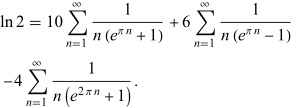
Plouffe (2006) found the beautiful sum
 |
(12)
|
A rapidly converging Zeilberger-type sum due to A. Lupas is given by
 |
(13)
|
(Lupas 2000; typos corrected).
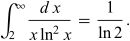
The following integral is given in terms of  ,
,
 |
(14)
|
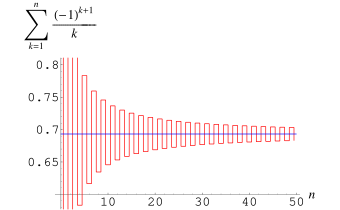
The plot above shows the result of truncating the series for  after
after  terms.
Taking the partial series gives the analytic result
 |  | ![ln2+1/2(-1)^N[psi_0(1/2(N+1))-psi_0(1+1/2N)]](/images/equations/NaturalLogarithmof2/Inline34.svg) |
(15)
|
 |  | ![ln2+1/2(-1)^N[H_((N-1)/2)-H_(N/2)],](/images/equations/NaturalLogarithmof2/Inline37.svg) |
(16)
|
where  is the digamma function and
  is a harmonic number.
Rather amazingly, expanding about infinity gives the series
is a harmonic number.
Rather amazingly, expanding about infinity gives the series
![sum_(k=1)^N((-1)^(k+1))/k=ln2+(-1)^N[1/(2N)+sum_(k=0)^infty((-1)^kT_k)/(4^kN^(2k))]](/images/equations/NaturalLogarithmof2/NumberedEquation8.svg) |
(17)
|
(Borwein and Bailey 2002, p. 50), where  is a tangent number. This
means that truncating the series for
is a tangent number. This
means that truncating the series for  at half a large power of 10 can give a decimal expansion
for
at half a large power of 10 can give a decimal expansion
for  whose decimal digits are largely correct, but where wrong digits occur with precise
regularity.
whose decimal digits are largely correct, but where wrong digits occur with precise
regularity.

For example, taking  gives a decimal value equal to the second row
of digits above, where the sequence of differences from the decimal digits of
gives a decimal value equal to the second row
of digits above, where the sequence of differences from the decimal digits of  in the top row is precisely the tangent numbers with alternating signs (Borwein and
Bailey 2002, p. 49).
in the top row is precisely the tangent numbers with alternating signs (Borwein and
Bailey 2002, p. 49).
Beautiful BBP-type formulas for  are given by
 |  | 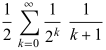 |
(18)
|
 |  |  |
(19)
|
(Bailey et al. 2007, p. 31) and
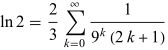 |
(20)
|
(Borwein and Bailey 2002, p. 129).
A BBP-type formula for  discovered using the PSLQ
algorithm is
discovered using the PSLQ
algorithm is
![(ln2)^2=1/(32)sum_(k=0)^infty1/(64^k)[(64)/((6k+1)^2)-(160)/((6k+2)^2)-(56)/((6k+3)^2)-(40)/((6k+4)^2)+4/((6k+5)^2)-1/((6k+6)^2)]](/images/equations/NaturalLogarithmof2/NumberedEquation10.svg) |
(21)
|
(Bailey and Plouffe 1997; Borwein and Bailey 2002, p. 128).
The sum
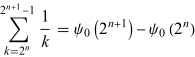 |
(22)
|
has the limit
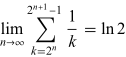 |
(23)
|
(Borwein et al. 2004, p. 10).

 ."
."  ,
,  ,
,  , and
, and  ." Amer. Math. Monthly 108, 222-231,
2001.Lupas, A. "Formulae for Some Classical Constants." In
Proceedings of ROGER-2000. 2000.
." Amer. Math. Monthly 108, 222-231,
2001.Lupas, A. "Formulae for Some Classical Constants." In
Proceedings of ROGER-2000. 2000.  by Rational Numbers." Vestnik Moskov Univ. Ser.
I Math. Mekh., No. 6, 25-29 and 97, 1987. [Russian].Sloane,
N. J. A. Sequences
by Rational Numbers." Vestnik Moskov Univ. Ser.
I Math. Mekh., No. 6, 25-29 and 97, 1987. [Russian].Sloane,
N. J. A. Sequences