


An NSW number (named after Newman, Shanks, and Williams) is an integer  that solves the Diophantine equation
 |
(1)
|
In other words, the NSW numbers  index the diagonals of squares of side length
  having the property that the squares of the diagonal
  equals one plus a square
number
equals one plus a square
number  .
Such numbers were called "rational diagonals" by the Greeks (Wells 1986,
p. 70). The name "NSW number" derives from the names of the authors
of the paper on the subject written by Newman et al. (1980/81).
.
Such numbers were called "rational diagonals" by the Greeks (Wells 1986,
p. 70). The name "NSW number" derives from the names of the authors
of the paper on the subject written by Newman et al. (1980/81).
The first few NSW numbers are therefore  , 7, 41, 239, 1393, ... (OEIS A002315),
which correspond to square side lengths
, 7, 41, 239, 1393, ... (OEIS A002315),
which correspond to square side lengths  , 5, 29, 169, 985, 5741, 33461, 195025, ... (OEIS A001653).
The values indexed by
, 5, 29, 169, 985, 5741, 33461, 195025, ... (OEIS A001653).
The values indexed by  and
and  therefore give 2, 50, 1682, 57122, ...
(OEIS A088920).
therefore give 2, 50, 1682, 57122, ...
(OEIS A088920).
Taking twice the NSW numbers gives the sequence 2, 14, 82, 478, 2786, 16238, ... (OEIS A077444), which is exactly every other Pell-Lucas number.
The first few prime NSW numbers are  , 41, 239, 9369319, 63018038201, 489133282872437279, ...
(OEIS A088165), corresponding to indices
, 41, 239, 9369319, 63018038201, 489133282872437279, ...
(OEIS A088165), corresponding to indices  , 2, 3, 9, 14, 23, 29, 81, 128, 210,
468, 473, 746, 950, 3344, 4043, 4839, 14376, 39521, 64563, 72984, 82899, 84338, 85206,
86121, 139160, ... (OEIS A113501).
, 2, 3, 9, 14, 23, 29, 81, 128, 210,
468, 473, 746, 950, 3344, 4043, 4839, 14376, 39521, 64563, 72984, 82899, 84338, 85206,
86121, 139160, ... (OEIS A113501).
The following table summarizes the largest known NSW primes, where the indices  correspond via
 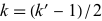 to the indices
  of prime half-Pell-Lucas numbers
that are odd.
of prime half-Pell-Lucas numbers
that are odd.
 | decimal digits | discoverer | date |
 |  | E. W. Weisstein | May 19, 2006 |
 |  | E. W. Weisstein | Aug. 29, 2006 |
 |  | E. W. Weisstein | Nov. 16, 2006 |
 |  | E. W. Weisstein | Nov. 26, 2006 |
 |  | E. W. Weisstein | Dec. 10, 2006 |
 |  | E. W. Weisstein | Jan. 25, 2007 |
 |  | R. Price | Dec. 7, 2018 |
Interestingly, the values  give every other convergent to Pythagoras's constant
  .
.
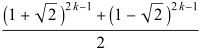
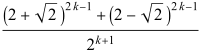
Explicit formula for  and
and  are given by
 |  |  |
(2)
|
 |  |  |
(3)
|
for positive integers  (Ribenboim 1996, p. 367). A recurrence relation
for
(Ribenboim 1996, p. 367). A recurrence relation
for  is given by
 |
(4)
|
with  and
and  .
.
