A magic tesseract is a four-dimensional generalization of the two-dimensional magic square and the three-dimensional magic
cube. A magic tesseract has magic constant
so for ,
2, ..., the magic tesseract constants are 1, 17, 123, 514, 1565, 3891, ... (OEIS
A021003).
Berlekamp et al. (1982, p. 783) give a magic tesseract. J. Hendricks has constructed magic tesseracts of orders three, four, five (Hendricks 1999a, pp. 128-129),
and six (Heinz). M. Houlton has used Hendricks' techniques to construct magic
tesseracts of orders 5, 7, and 9.
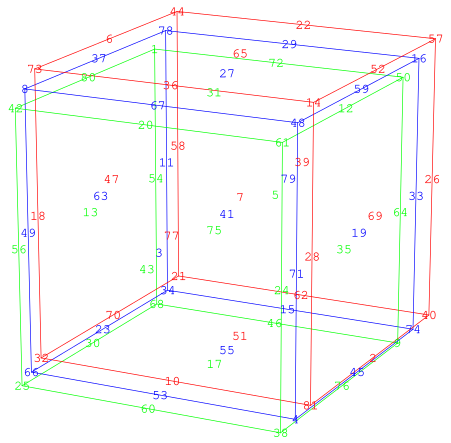
There are 58 distinct magic tesseracts of order three, modulo rotations and reflections (Heinz, Hendricks 1999), one of which is illustrated above. Each of the 27 rows (e.g., 1-72-50), columns (e.g., 1-80-42), pillars (e.g., 1-54-68), and files (e.g., 1-78-44) sum to the magic constant 123.
Hendricks (1968) has constructed a pan-4-agonal magic tesseract of order 4. No pan-4-agonal magic tesseract of order five is known, and Andrews (1960) and Schroeppel (1972) state that no such tesseract can exist.
The smallest perfect magic tesseract is of order 16, having magic constant,
and has been constructed by Hendricks (Peterson 1999).
-dimensional magic hypercubes of order
3 are known for ,
6, 7, and 8 (Hendricks). Hendricks has also constructed a perfect 16th order magic
tesseract (where perfect means that all hyperplanes are perfect).
In 2003, Christian Boyer constructed the first bimagic and trimagic tesseracts.



 ,
2, ..., the magic tesseract constants are 1, 17, 123, 514, 1565, 3891, ... (OEIS
A021003).
,
2, ..., the magic tesseract constants are 1, 17, 123, 514, 1565, 3891, ... (OEIS
A021003).
 ,
and has been constructed by Hendricks (Peterson 1999).
,
and has been constructed by Hendricks (Peterson 1999).
 -dimensional magic hypercubes of order
3 are known for
-dimensional magic hypercubes of order
3 are known for  ,
6, 7, and 8 (Hendricks). Hendricks has also constructed a perfect 16th order magic
tesseract (where perfect means that all hyperplanes are perfect).
,
6, 7, and 8 (Hendricks). Hendricks has also constructed a perfect 16th order magic
tesseract (where perfect means that all hyperplanes are perfect).

 -Dimensional Magic Hypercubes." J. Recr. Math. 6,
193-201, 1973.Hendricks, J. R. "Ten Magic Tesseracts of Order
Three." J. Recr. Math. 18, 125-134, 1985-1986.Hendricks,
J. R. Magic Squares to Tesseracts by Computer. Published by the author,
1999a.Hendricks, J. R. All Third Order Magic Tesseracts.
Published by the author, 1999b.Hendricks, J. R. Perfect
-Dimensional Magic Hypercubes." J. Recr. Math. 6,
193-201, 1973.Hendricks, J. R. "Ten Magic Tesseracts of Order
Three." J. Recr. Math. 18, 125-134, 1985-1986.Hendricks,
J. R. Magic Squares to Tesseracts by Computer. Published by the author,
1999a.Hendricks, J. R. All Third Order Magic Tesseracts.
Published by the author, 1999b.Hendricks, J. R. Perfect  -Dimensional Hypercubes of Order
  . Published by the author, 1999c.Hendricks,
J. R. Erratum to 'Magic Tesseracts and
. Published by the author, 1999c.Hendricks,
J. R. Erratum to 'Magic Tesseracts and  -Dimensional Magic Hypercubes." J. Recr. Math. 7,
80, 1974.Peterson, I. "Ivar Peterson's MathTrek: Magic Tesseracts."
-Dimensional Magic Hypercubes." J. Recr. Math. 7,
80, 1974.Peterson, I. "Ivar Peterson's MathTrek: Magic Tesseracts."
 -Dimensional
Cubes of Order
-Dimensional
Cubes of Order  (mod 4)." Acta Arith. 92, 189-194, 2000b.Trenkler,
M. "Magic
(mod 4)." Acta Arith. 92, 189-194, 2000b.Trenkler,
M. "Magic  -Dimensional
Cubes." Acta Arith. 96, 361-364, 2001.
-Dimensional
Cubes." Acta Arith. 96, 361-364, 2001.