


A linear transformation between two vector spaces  and
and  is a map
  such that the following hold:
1.  for any vectors
  and
and  in
in  , and
, and
2.  for any scalar
  .
.
A linear transformation may or may not be injective or surjective. When  and
and  have the same dimension, it
is possible for
have the same dimension, it
is possible for  to be invertible, meaning there exists a
  such that
  . It is always the case that
  . Also, a linear transformation always maps lines
to lines (or to zero).
. Also, a linear transformation always maps lines
to lines (or to zero).

|

|
The main example of a linear transformation is given by matrix multiplication. Given an  matrix
  , define
  , where
  is written as a column vector
(with
is written as a column vector
(with  coordinates). For example, consider
![A=[0 1; -2 2; 1 0],](/images/equations/LinearTransformation/NumberedEquation1.svg) |
(1)
|
then  is a linear transformation from
  to
to  , defined by
 |
(2)
|
When  and
and  are finite dimensional, a general linear transformation
can be written as a matrix multiplication only after specifying a vector
basis for
are finite dimensional, a general linear transformation
can be written as a matrix multiplication only after specifying a vector
basis for  and
and  .
When
.
When  and
and  have an inner product, and their vector
bases,
have an inner product, and their vector
bases,  and
and  ,
are orthonormal, it is easy to write the corresponding
matrix
,
are orthonormal, it is easy to write the corresponding
matrix  .
In particular,
.
In particular, 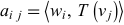 .
Note that when using the standard basis for
.
Note that when using the standard basis for  and
and  , the
, the  th column corresponds to the image of the
  th standard basis vector.
When  and
and  are infinite dimensional, then it is possible for a
linear transformation to not be continuous. For example,
let
are infinite dimensional, then it is possible for a
linear transformation to not be continuous. For example,
let  be the space of polynomials in one variable, and
  be the derivative. Then
  , which is not continuous
because
, which is not continuous
because  while
while  does not converge.
Linear two-dimensional transformations have a simple classification. Consider the two-dimensional linear transformation
 |  |  |
(3)
|
 |  | 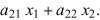 |
(4)
|
Now rescale by defining  and
and  . Then the above equations become
 |
(5)
|
where  and
and  ,
,
 ,
,
 ,
and
,
and  are defined in terms of the old constants. Solving for
  gives
gives
 |
(6)
|
so the transformation is one-to-one. To find the fixed points of the transformation, set  to obtain
 |
(7)
|
This gives two fixed points, which may be distinct or coincident. The fixed points are classified as follows.



