


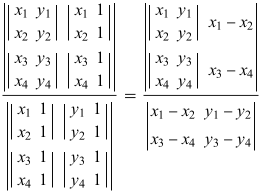
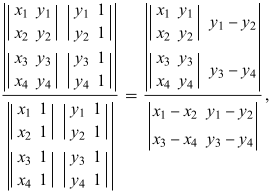
The intersection of two lines  and
and  in two dimensions with,
  containing the points
  and
and  , and
, and  containing the points
  and
and  , is given by
 |  |  |
(1)
|
 |  |  |
(2)
|
where  denotes a determinant. This corresponds to simultaneously
solving
denotes a determinant. This corresponds to simultaneously
solving
 |  |  |
(3)
|
 |  |  |
(4)
|
for  and
and  .
Other treatments are given by Antonio (1992) and Hill (1994).
.
Other treatments are given by Antonio (1992) and Hill (1994).
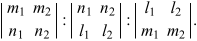
The intersections of two lines given in trilinear coordinates as
 |  |  |
(5)
|
 |  |  |
(6)
|
is
 |
(7)
|
Pseudocode for segment intersection is given by de Berg et al. (2000).
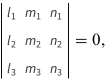
Three lines in trilinear coordinates
 |  |  |
(8)
|
 |  |  |
(9)
|
 |  |  |
(10)
|
concur if their trilinear coordinates satisfy
 |
(11)
|
in which case the point is
 |
(12)
|
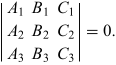
Three lines in Cartesian coordinates concur if the coefficients of the lines
 |  |  |
(13)
|
 |  |  |
(14)
|
 |  |  |
(15)
|
satisfy
 |
(16)
|
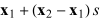
In three dimensions, the algebra becomes more complicated. The intersection of two lines containing the points  and
and  , and
, and  and
and  , respectively, can also be found directly
by simultaneously solving
, respectively, can also be found directly
by simultaneously solving
 |  |  |
(17)
|
 |  |  |
(18)
|
together with the condition that the four points be coplanar (i.e., the lines are not skew),
![|x_1 y_1 z_1 1; x_2 y_2 z_2 1; x_3 y_3 z_3 1; x_4 y_4 z_4 1|=(x_3-x_1)·[(x_2-x_1)x(x_4-x_3)]=0](/images/equations/Line-LineIntersection/NumberedEquation5.svg) |
(19)
|
for  ,
eliminating
,
eliminating  and
and  .
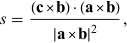
This set of equations can be solved for
.
This set of equations can be solved for  to yield
 |
(20)
|
where
 |  |  |
(21)
|
 |  |  |
(22)
|
 |  |  |
(23)
|
(Hill 1994).
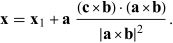
The point of intersection can then be immediately found by plugging back in for  to obtain
 |
(24)
|
A slightly more symmetrical and concise form can obtained by additionally defining
 |  |  |
(25)
|
 |  |  |
(26)
|
 |  |  |
(27)
|
where  denotes a unit vector, then
 |
(28)
|
(Goldman 1990).
