


Find the plane lamina of least area  which is capable of covering any plane figure of unit generalized
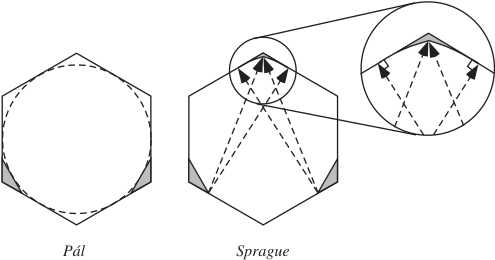
diameter. A unit circle is too small, but a hexagon circumscribed on the unit
circle is larger than necessary. Pál (1920) showed that the hexagon can
be reduced by cutting off two isosceles triangles
on the corners of the hexagon which are tangent to the hexagon's incircle
(Wells 1991; left figure above). Sprague subsequently demonstrated that an additional
small curvilinear region could be removed (Wells 1991; right figure above). These
constructions give upper bounds.
which is capable of covering any plane figure of unit generalized
diameter. A unit circle is too small, but a hexagon circumscribed on the unit
circle is larger than necessary. Pál (1920) showed that the hexagon can
be reduced by cutting off two isosceles triangles
on the corners of the hexagon which are tangent to the hexagon's incircle
(Wells 1991; left figure above). Sprague subsequently demonstrated that an additional
small curvilinear region could be removed (Wells 1991; right figure above). These
constructions give upper bounds.
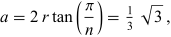
The hexagon having inradius  (giving a diameter of 1) has side length
 |
(1)
|
and the area of this hexagon is
 |
(2)
|
(OEIS A010527).
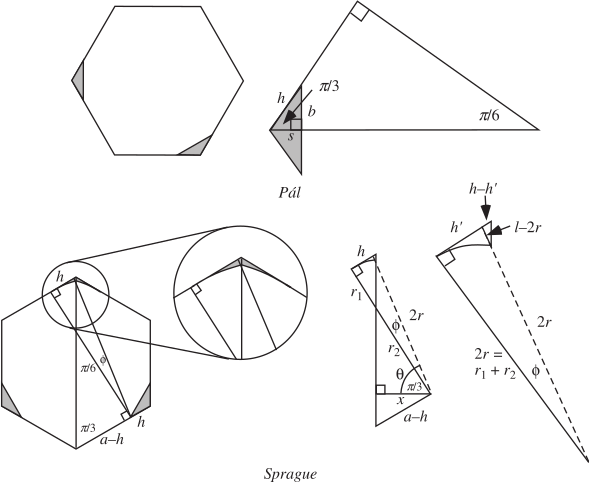
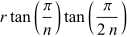
In the above figure, the sagitta is given by
 |  |  |
(3)
|
 |  |  |
(4)
|
and the other distances by
 |  | 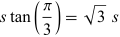 |
(5)
|
 |  | 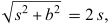 |
(6)
|
so the area of one of the equilateral triangles removed in Pál's reduction is
 |  |  |
(7)
|
 |  |  |
(8)
|
 |  | 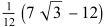 |
(9)
|
 |  |  |
(10)
|
so the area left after removing two of these triangles is
 |  |  |
(11)
|
 |  |  |
(12)
|
 |  |  |
(13)
|
(OEIS A093821).
Computing the area of the region removed in Sprague's construction is more involved. First, use similar triangles
 |
(14)
|
together with  to obtain
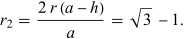 |
(15)
|
Then
 |
(16)
|
and the angle  is given by
![theta=cos^(-1)(x/(2r))=cos^(-1)[1/2(sqrt(3)-1)],](/images/equations/LebesgueMinimalProblem/NumberedEquation6.svg) |
(17)
|
and the angle  is just
 |
(18)
|
The distance  is
is
 |  |  |
(19)
|
 |  |  |
(20)
|
and the area between the triangle and sector is
 |  |  |
(21)
|
 |  |  |
(22)
|
 |  |  |
(23)
|
 |  |  |
(24)
|
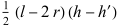
The area of the small triangle is
 |  |  |
(25)
|
 |  |  |
(26)
|
 |  |  |
(27)
|
so the total area remaining is
 |  |  |
(28)
|
 |  | ![-(109)/(121)-(82)/(121sqrt(3))+2/(121)sqrt(28634sqrt(3)-35139)-1/3pi+cos^(-1)[1/2(sqrt(3)-1)]](/images/equations/LebesgueMinimalProblem/Inline72.svg) |
(29)
|
 |  |  |
(30)
|
(OEIS A093822).
It is also known that a lower bound for the area is given by
 |
(31)
|
(Ogilvy 1990).
