The problem of determining how many nonattacking knights can be placed on an chessboard. For , the solution is 32 (illustrated above).
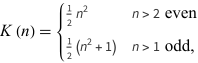
In general, the solutions are
(1)
giving the sequence 1, 4, 5, 8, 13, 18, 25, ... (OEIS A030978,
Dudeney 1970, p. 96; Madachy 1979).
The minimal number of knights needed to occupy or attack every square on an chessboard
(i.e., domination numbers for the knight graphs) are
given for ,
2, ... by 1, 4, 4, 4, 5, 8, 10, 12, 14, ... (OEIS A006075),
with corresponding numbers of such solutions given by 1, 1, 2, 3, 8, 22, 3, ... (OEIS
A006076).


 can be placed on an
  chessboard. For
  , the solution is 32 (illustrated above).
In general, the solutions are
, the solution is 32 (illustrated above).
In general, the solutions are

 chessboard
(i.e., domination numbers for the
chessboard
(i.e., domination numbers for the  knight graphs) are
given for
knight graphs) are
given for  ,
2, ... by 1, 4, 4, 4, 5, 8, 10, 12, 14, ... (OEIS A006075),
with corresponding numbers of such solutions given by 1, 1, 2, 3, 8, 22, 3, ... (OEIS
A006076).
,
2, ... by 1, 4, 4, 4, 5, 8, 10, 12, 14, ... (OEIS A006075),
with corresponding numbers of such solutions given by 1, 1, 2, 3, 8, 22, 3, ... (OEIS
A006076).
