

The Kubo-Martin-Schwinger (KMS) condition is a kind of boundary-value condition which naturally emerges in quantum statistical mechanics and related areas.
Given a quantum system  with finite dimensional Hilbert space
  , define the function
  as
as
 |
(1)
|
where  is the imaginary unit and where
  is the Hamiltonian, i.e., the sum of the kinetic energies
of all the particles in
is the Hamiltonian, i.e., the sum of the kinetic energies
of all the particles in  plus the potential energy of the particles associated with
  . Next, for any real number
  , define the thermal equilibrium
 as
as
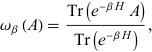 |
(2)
|
where  denotes the matrix trace. From
  and
and  , one can define the so-called equilibrium correlation
function
, one can define the so-called equilibrium correlation
function  where
where
 |
(3)
|
whereby the KMS boundary condition says that
 |
(4)
|
In particular, this identity relates to the state  the values of the analytic
function
the values of the analytic
function  on the boundary of the strip
 |
(5)
|
where here,  denotes the imaginary part of
  and
and  denotes the signum function
applied to
denotes the signum function
applied to  .
.
In various literature, the KMS boundary condition is stated in sometimes-different contexts. For example, the identity (4) is sometimes written with respect to integration, yielding
 |
(6)
|
where here,  is used as shorthand for
  .
In other literature (e.g., Araki and Miyata 1968), the condition looks different
still.
.
In other literature (e.g., Araki and Miyata 1968), the condition looks different
still.
