


The isoperimetric quotient of a closed curve is defined as the ratio of the curve area to the area of a circle ( ) with same perimeter (
 ) as the curve,
 |  |  |
(1)
|
 |  |  |
(2)
|
 |  |  |
(3)
|
where  is the area of the plane figure and
  is its perimeter. The isoperimetric
inequality gives
is its perimeter. The isoperimetric
inequality gives  , with equality only in the case of the circle.

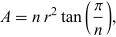
For a regular  -gon
with inradius
-gon
with inradius  , the area is given by
 |
(4)
|
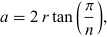
edge length by
 |
(5)
|
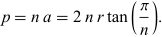
and the perimeter is given by
 |
(6)
|
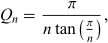
Thus,
 |
(7)
|
which converges to 1 for  .
.
The isoperimetric quotient can similarly be defined for a polyhedron, where it is defined as the dimensionless quantity obtained using the volume (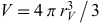 )
and surface area (
)
and surface area ( ) of the sphere as a reference,
 |  |  |
(8)
|
 |  |  |
(9)
|
 |  |  |
(10)
|
