

An irreducible representation of a group is a group representation that has no nontrivial invariant subspaces. For example, the orthogonal group  has an irreducible representation on
  .
.
Any representation of a finite or semisimple Lie group breaks up into a direct sum of irreducible
representations. But in general, this is not the case, e.g.,  has a representation on
  by
by
![phi(a)=[1 a; 0 1],](/images/equations/IrreducibleRepresentation/NumberedEquation1.svg) |
(1)
|
i.e.,  .
But the subspace
.
But the subspace  is fixed, hence
  is not irreducible, but there is no complementary invariant
subspace.
is not irreducible, but there is no complementary invariant
subspace.
The irreducible representation has a number of remarkable properties, as formalized in the group orthogonality theorem.
Let the group order of a group
be  ,
and the dimension of the
,
and the dimension of the  th representation (the order of each constituent matrix) be
 (a positive integer). Let any operation be denoted
 ,
and let the
,
and let the  th
row and
th
row and  th
column of the matrix corresponding to a matrix
th
column of the matrix corresponding to a matrix  in the
  th irreducible representation be
  . The following properties can be derived from
the group orthogonality theorem,
. The following properties can be derived from
the group orthogonality theorem,
 |
(2)
|
1. The dimensionality theorem:
 |
(3)
|
where each  must be a positive integer and
  is the group character
(trace) of the representation.
is the group character
(trace) of the representation.
2. The sum of the squares of the group characters in any irreducible representation  equals
  ,
,
 |
(4)
|
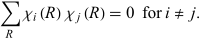
3. Orthogonality of different representations
 |
(5)
|
4. In a given representation, reducible or irreducible, the group characters of all matrices belonging to operations in the same class are identical (but differ from those in other representations).
5. The number of irreducible representations of a group is equal to the number of conjugacy classes in
the group. This number is the dimension of the  matrix (although some may have
zero elements).
matrix (although some may have
zero elements).
6. A one-dimensional representation with all 1s (totally symmetric) will always exist for any group.
7. A one-dimensional representation for a group with elements expressed as matrices can be found by taking the group characters of the matrices.
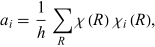
8. The number  of irreducible representations
  present in a reducible representation
  is given by
 |
(6)
|
where  is the group order of the group
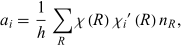
and the sum must be taken over all elements in each class. Written explicitly,
is the group order of the group
and the sum must be taken over all elements in each class. Written explicitly,
 |
(7)
|
where  is the group character of a single entry in the
character table and
is the group character of a single entry in the
character table and  is the number of elements in the corresponding conjugacy
class.
is the number of elements in the corresponding conjugacy
class.
Irreducible representations can be indicated using Mulliken symbols.
