


The hyperbolic functions  ,
,  ,
,  ,
,  ,
,  ,
,  (hyperbolic sine, hyperbolic cosine, hyperbolic
tangent, hyperbolic cosecant, hyperbolic
secant, and hyperbolic cotangent) are
analogs of the trigonometric functions,
obtained by removing factors of
(hyperbolic sine, hyperbolic cosine, hyperbolic
tangent, hyperbolic cosecant, hyperbolic
secant, and hyperbolic cotangent) are
analogs of the trigonometric functions,
obtained by removing factors of  from their formulas in terms of
  . For example,
 |
(1)
|
so
 |
(2)
|
Note that alternate notations are sometimes used, as summarized in the following table.
 | alternate notations |
 |  (Gradshteyn and Ryzhik 2000, p. xxvii)
 |
 |  (Gradshteyn and Ryzhik 2000, p. xxvii) (Gradshteyn and Ryzhik 2000, p. xxvii) |
 |  (Gradshteyn and Ryzhik 2000, p. xxvii) (Gradshteyn and Ryzhik 2000, p. xxvii) |
 |  (Gradshteyn and Ryzhik 2000, p. xxvii) (Gradshteyn and Ryzhik 2000, p. xxvii) |
The hyperbolic functions share many properties with the corresponding trigonometric functions. In fact, just as the circle can be represented parametrically by
 |  |  |
(3)
|
 |  |  |
(4)
|
a rectangular hyperbola (or, more specifically, its right branch) can be analogously represented by
 |  |  |
(5)
|
 |  |  |
(6)
|
where  is the hyperbolic cosine and
  is the hyperbolic sine.
The parameter  also has an area interpretation analogous to the angle parameter for the unit
circle. On the unit rectangular hyperbola
also has an area interpretation analogous to the angle parameter for the unit
circle. On the unit rectangular hyperbola  , the signed area
bounded by the positive
, the signed area
bounded by the positive  -axis, the ray from the origin
to
-axis, the ray from the origin
to  ,
and the hyperbolic arc between them is
,
and the hyperbolic arc between them is  . Thus
  is twice this signed area.
The hyperbolic functions arise in many problems of mathematics and mathematical physics in which integrals involving  arise (whereas the trigonometric
functions involve
arise (whereas the trigonometric
functions involve  ). For instance, the hyperbolic
sine arises in the gravitational potential of a cylinder and the calculation
of the Roche limit. The hyperbolic cosine function
is the shape of a hanging cable (the so-called catenary).
The hyperbolic tangent arises in the calculation
of and rapidity of special relativity. All three appear in the Schwarzschild metric
using external isotropic Kruskal coordinates in general relativity. The hyperbolic
secant arises in the profile of a laminar jet. The hyperbolic
cotangent arises in the Langevin function for magnetic polarization.
). For instance, the hyperbolic
sine arises in the gravitational potential of a cylinder and the calculation
of the Roche limit. The hyperbolic cosine function
is the shape of a hanging cable (the so-called catenary).
The hyperbolic tangent arises in the calculation
of and rapidity of special relativity. All three appear in the Schwarzschild metric
using external isotropic Kruskal coordinates in general relativity. The hyperbolic
secant arises in the profile of a laminar jet. The hyperbolic
cotangent arises in the Langevin function for magnetic polarization.
The hyperbolic functions are defined by
 |  |  |
(7)
|
 |  |  |
(8)
|
 |  |  |
(9)
|
 |  |  |
(10)
|
 |  |  |
(11)
|
 |  |  |
(12)
|
 |  |  |
(13)
|
 |  |  |
(14)
|
 |  |  |
(15)
|
 |  |  |
(16)
|
For arguments multiplied by  ,
,
 |
(17)
|
 |
(18)
|
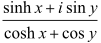
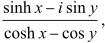
The hyperbolic functions satisfy many identities analogous to the trigonometric identities (which can be inferred using Osborn's rule) such as
 |  |  |
(19)
|
 |  |  |
(20)
|
 |  |  |
(21)
|
See also Beyer (1987, p. 168).
Some half-angle formulas are
 |  |  |
(22)
|
 |  |  |
(23)
|
where  .
.
Some double-angle formulas are
 |  |  |
(24)
|
 |  |  |
(25)
|
 |  |  |
(26)
|
Identities for complex arguments include
 |  |  |
(27)
|
 |  |  |
(28)
|
The absolute squares for complex arguments are
 |  |  |
(29)
|
 |  |  |
(30)
|
