

A Horn function is a multiple power series
 |
(1)
|
for which, for each  ,
...,
,
...,  ,
the ratio of neighboring coefficients is a rational
function of the summation indices,
,
the ratio of neighboring coefficients is a rational
function of the summation indices,
 |
(2)
|
where  and
and 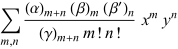 are polynomials.
The series is called complete if, for each
are polynomials.
The series is called complete if, for each  , ...,
  , the limits
 |
(3)
|
exist and are neither identically zero nor equal to infinity (Horn 1931).
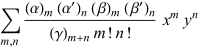
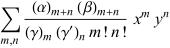
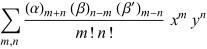
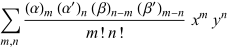
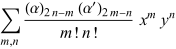
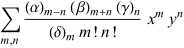
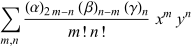
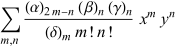
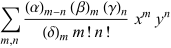
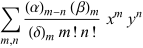
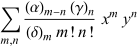
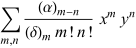
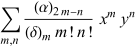
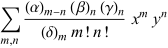
Horn (1931) enumerated 34 distinct two-variable hypergeometric series that converge in nonempty regions, with
corrections by Borngässer (1933). There are 14 complete series for which 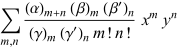 :
:
 |  |  |
(4)
|
 |  |  |
(5)
|
 |  |  |
(6)
|
 |  |  |
(7)
|
 |  |  |
(8)
|
 |  |  |
(9)
|
 |  | 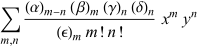 |
(10)
|
 |  | 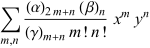 |
(11)
|
 |  | 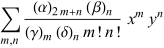 |
(12)
|
 |  | 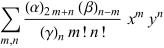 |
(13)
|
 |  |  |
(14)
|
 |  |  |
(15)
|
 |  |  |
(16)
|
 |  |  |
(17)
|
(of which  ,
,
 ,
,  , and
, and 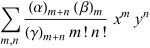 are precisely Appell
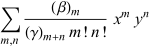
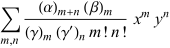
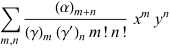
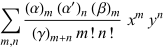
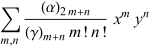
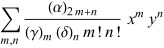
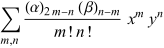
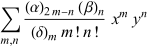
hypergeometric functions), and 20 confluent series with
are precisely Appell
hypergeometric functions), and 20 confluent series with  ,
,  , and
, and 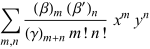 not both 2:
 |  |  |
(18)
|
 |  |  |
(19)
|
 |  |  |
(20)
|
 |  |  |
(21)
|
 |  | 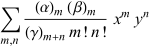 |
(22)
|
 |  | 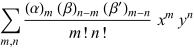 |
(23)
|
 |  | 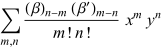 |
(24)
|
 |  | 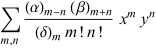 |
(25)
|
 |  |  |
(26)
|
 |  |  |
(27)
|
 |  |  |
(28)
|
 |  |  |
(29)
|
 |  |  |
(30)
|
 |  |  |
(31)
|
 |  |  |
(32)
|
 |  |  |
(33)
|
 |  |  |
(34)
|
 |  |  |
(35)
|
 |  |  |
(36)
|
 |  |  |
(37)
|
(Erdélyi et al. 1981, pp. 224-226; Srivastava and Karlsson 1985, pp. 24-26). Here, the sums are taken over nonnegative integers  and
and  .
.
Note that  ,
,
 , and
, and  as defined by Erdélyi et al. (1981) are erroneous;
the correct formulas given above may be found in Srivastava and Karlsson (1985, pp. 25-26).
as defined by Erdélyi et al. (1981) are erroneous;
the correct formulas given above may be found in Srivastava and Karlsson (1985, pp. 25-26).
The rational coefficient ratios determine an associated Horn system that annihilates the series.
