

The Hammer-Aitoff equal-area projection, also called the Hammer projection, is a map projection that is a modification of the Lambert azimuthal equal-area projection. It consists of halving the vertical coordinates of the equatorial aspect of one hemisphere and doubling the values of the meridians from the center (Snyder 1987, p. 182). Like the Lambert azimuthal equal-area projection, it is equal area, but it is no longer azimuthal.
For a unit sphere with central meridian  , let
, let  be the longitude and
  the latitude, measured in radians. Applying the modification
above to the equatorial Lambert
azimuthal equal-area projection formulas (Snyder 1987, p. 185) gives the
projected Cartesian coordinates
the latitude, measured in radians. Applying the modification
above to the equatorial Lambert
azimuthal equal-area projection formulas (Snyder 1987, p. 185) gives the
projected Cartesian coordinates  and
and  as
as
 |  |  |
(1)
|
 |  |  |
(2)
|
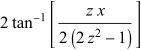
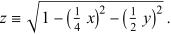
For the inverse projection, define the intermediate variable
 |
(3)
|
Then the longitude and latitude are given by
 |  | ![2tan^(-1)[(zx)/(2(2z^2-1))]](/images/equations/Hammer-AitoffEqual-AreaProjection/Inline14.svg) |
(4)
|
 |  |  |
(5)
|
In the longitude formula, the inverse tangent takes the signs of both  and
and  into account to select the correct quadrant.
