


A geodesic is a locally length-minimizing curve. Equivalently, it is a path that a particle which is not accelerating would follow. In the plane, the geodesics are straight lines. On the sphere, the geodesics are great circles (like the equator). The geodesics in a space depend on the Riemannian metric, which affects the notions of distance and acceleration.
Geodesics preserve a direction on a surface (Tietze 1965, pp. 26-27) and have many other interesting properties. The normal vector to any point of a geodesic arc lies along the normal to a surface at that point (Weinstock 1974, p. 65).
Furthermore, no matter how badly a sphere is distorted, there exist an infinite number of closed geodesics on it. This general result, demonstrated in the early 1990s, extended earlier work by Birkhoff, who proved in 1917 that there exists at least one closed geodesic on a distorted sphere, and Lyusternik and Schnirelmann, who proved in 1923 that there exist at least three closed geodesics on such a sphere (Cipra 1993, p. 28).
For a surface given parametrically by  ,
,  , and
, and  , the geodesic can be found by minimizing the arc
length
, the geodesic can be found by minimizing the arc
length
 |
(1)
|
But
 |  | 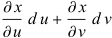 |
(2)
|
 |  |  |
(3)
|
and similarly for  and
and  . Plugging in,
![I=int{[((partialx)/(partialu))^2+((partialy)/(partialu))^2+((partialz)/(partialu))^2]du^2+2[(partialx)/(partialu)(partialx)/(partialv)+(partialy)/(partialu)(partialy)/(partialv)+(partialz)/(partialu)(partialz)/(partialv)]dudv+[((partialx)/(partialv))^2+((partialy)/(partialv))^2+((partialz)/(partialv))^2]dv^2}^(1/2).](/images/equations/Geodesic/NumberedEquation2.svg) |
(4)
|
This can be rewritten as
 |  | 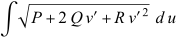 |
(5)
|
 |  | 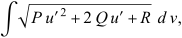 |
(6)
|
where
 |  |  |
(7)
|
 |  |  |
(8)
|
and
 |  | 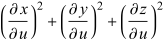 |
(9)
|
 |  | 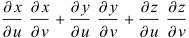 |
(10)
|
 |  | 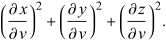 |
(11)
|
Starting with equation (5)
 |  | 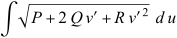 |
(12)
|
 |  |  |
(13)
|
and taking derivatives,
 |  |  |
(14)
|
 |  |  |
(15)
|
so the Euler-Lagrange differential equation then gives
 |
(16)
|
In the special case when  ,
,
 , and
, and  are explicit functions of
  only,
only,
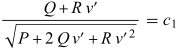 |
(17)
|
 |
(18)
|
 |
(19)
|
![v^'=1/(2R(R-c_1^2))[2Q(c_1^2-R)+/-sqrt(4Q^2(R-c_1^2)^2-4R(R-c_1^2)(Q^2-Pc_1^2))].](/images/equations/Geodesic/NumberedEquation7.svg) |
(20)
|
Now, if  and
and  are explicit functions of
  only and
  ,
,
 |
(21)
|
so
 |
(22)
|
In the case  where
where  and
and  are explicit functions of
  only, then
 |
(23)
|
so
![(partialP)/(partialv)+v^('2)(partialR)/(partialv)-2sqrt(P+Rv^('2))R[(v^(''))/(sqrt(P+Rv^('2)))+(-1/2)(v^'(2Rv^'v^('')))/((P+Rv^('2))^(3/2))]=0](/images/equations/Geodesic/NumberedEquation11.svg) |
(24)
|
 |
(25)
|
 |
(26)
|
 |
(27)
|
 |
(28)
|
 |
(29)
|
and
 |
(30)
|
For a surface of revolution in which  is rotated about the x-axis
so that the equation of the surface is
is rotated about the x-axis
so that the equation of the surface is
 |
(31)
|
the surface can be parameterized by
 |  |  |
(32)
|
 |  |  |
(33)
|
 |  |  |
(34)
|
The equation of the geodesics is then
![v=c_1int(sqrt(1+[g^'(u)]^2)du)/(g(u)sqrt([g(u)]^2-c_1^2)).](/images/equations/Geodesic/NumberedEquation19.svg) |
(35)
|
