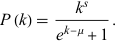
The Fermi-Dirac distribution is a continuous distribution arising in the study of half-integer spin particles. For and , a common form has probability density proportional
to
National Institute of Standards and Technology. "Fermi-Dirac and Bose-Einstein Integrals." §25.12(iii) in Digital Library of Mathematical
Functions.https://dlmf.nist.gov/25.12#iii.


 and
and  , a common form has probability density proportional
to
, a common form has probability density proportional
to
 is a real number.





 is the Lerch transcendent and
  is a polylogarithm.
