Fermat found the smallest Diophantine 1-quadruple: (Davenport and Baker 1969, Jones 1976). There are
no others with largest term , and Davenport and Baker (1969) showed that if , , and are all squares, then .
is
(Dujella 1996). Dujella (1993) showed there exist no Diophantine quadruples .
A longstanding conjecture is that no integer Diophantine quintuple exists (Gardner 1967, van Lint 1968, Davenport and Baker 1969, Kanagasabapathy and Ponnudurai 1975, Sansone 1976, Grinstead 1978).
Jones (1976) derived an infinite sequence of polynomials such that the product of any two
consecutive polynomials, increased by 1, is the square of a polynomial. Letting , then the general
is given by the recurrence relation
(5)
The first few
are
(6)
(7)
(8)
Letting
gives the sequence ,
3, 8, 120, 1680, 23408, 326040, ... (OEIS A051047),
for which
is 2, 5, 31, 449, 6271, 87361, ... (OEIS A051048).
Brown, E. "Sets in Which is Always a Square." Math. Comput.45,
613-620, 1985.Davenport, H. and Baker, A. "The Equations and ." Quart. J. Math. (Oxford) Ser. 220,
129-137, 1969.Diofant Aleksandriĭskiĭ. Arifmetika i kniga
o mnogougol'nyh chislakh [Russian]. Moscow: Nauka, 1974.Dujella,
A. "Generalization of a Problem of Diophantus." Acta Arith.65,
15-27, 1993.Dujella, A. "Diophantine Quadruples for Squares of
Fibonacci and Lucas Numbers." Portugaliae Math.52, 305-318, 1995.Dujella,
A. "Generalized Fibonacci Numbers and the Problem of Diophantus." Fib.
Quart.34, 164-175, 1996.Dujella, A. "Diophantine -Tuples-Introduction." http://web.math.hr/~duje/intro.html.Gardner,
M. "Mathematical Diversions." Sci. Amer.216, 124, 1967.Grinstead,
C. M. "On a Method of Solving a Class of Diophantine Equations." Math.
Comput.32, 936-940, 1978.Hoggatt, V. E. Jr. and Bergum,
G. E. "A Problem of Fermat and the Fibonacci Sequence." Fib. Quart.15,
323-330, 1977.Jones, B. W. "A Variation of a Problem of Davenport
and Diophantus." Quart. J. Math. (Oxford) Ser. (2)27, 349-353,
1976.Kanagasabapathy, P. and Ponnudurai, T. "The Simultaneous Diophantine
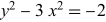
Equations
and ."
Quart. J. Math. (Oxford) Ser. (2)26, 275-278, 1975.Morgado,
J. "Generalization of a Result of Hoggatt and Bergum on Fibonacci Numbers."
Portugaliae Math.42, 441-445, 1983-1984.Sansone, G. "Il
sistema diofanteo ,
,
."
Ann. Mat. Pura Appl.111, 125-151, 1976.Sloane, N. J. A.
Sequences A050269, A050269,
A050273, A050274,
A050275, A051047,
and A051048 in "The On-Line Encyclopedia
of Integer Sequences."van Lint, J. H. "On a Set of Diophantine
Equations." T. H.-Report 68-WSK-03. Department of Mathematics. Eindhoven,
Netherlands: Technological University Eindhoven, 1968.


 distinct positive integers
  satisfies the Diophantus property
  of order
  (a positive integer) if, for all
  , ...,
  with
with  ,
,
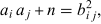
 s
are integers. The set
s
are integers. The set  is called a Diophantine
  -tuple.
 (Davenport and Baker 1969, Jones 1976). There are
no others with largest term
(Davenport and Baker 1969, Jones 1976). There are
no others with largest term  , and Davenport and Baker (1969) showed that if
  ,
,  , and
, and  are all squares, then
  .
.
 quadruples are

 are Fibonacci numbers, and


 (Dujella 1996). Dujella (1993) showed there exist no Diophantine quadruples
  .
.
 such that the product of any two
consecutive polynomials, increased by 1, is the square of a polynomial. Letting
such that the product of any two
consecutive polynomials, increased by 1, is the square of a polynomial. Letting  , then the general
 is given by the recurrence relation

 are
are






 gives the sequence
  ,
3, 8, 120, 1680, 23408, 326040, ... (OEIS A051047),
for which
,
3, 8, 120, 1680, 23408, 326040, ... (OEIS A051047),
for which  is 2, 5, 31, 449, 6271, 87361, ... (OEIS A051048).

 is Always a Square." Math. Comput. 45,
613-620, 1985.Davenport, H. and Baker, A. "The Equations
is Always a Square." Math. Comput. 45,
613-620, 1985.Davenport, H. and Baker, A. "The Equations  and
and  ." Quart. J. Math. (Oxford) Ser. 2 20,
129-137, 1969.Diofant Aleksandriĭskiĭ. Arifmetika i kniga
o mnogougol'nyh chislakh [Russian]. Moscow: Nauka, 1974.Dujella,
A. "Generalization of a Problem of Diophantus." Acta Arith. 65,
15-27, 1993.Dujella, A. "Diophantine Quadruples for Squares of
Fibonacci and Lucas Numbers." Portugaliae Math. 52, 305-318, 1995.Dujella,
A. "Generalized Fibonacci Numbers and the Problem of Diophantus." Fib.
Quart. 34, 164-175, 1996.Dujella, A. "Diophantine
." Quart. J. Math. (Oxford) Ser. 2 20,
129-137, 1969.Diofant Aleksandriĭskiĭ. Arifmetika i kniga
o mnogougol'nyh chislakh [Russian]. Moscow: Nauka, 1974.Dujella,
A. "Generalization of a Problem of Diophantus." Acta Arith. 65,
15-27, 1993.Dujella, A. "Diophantine Quadruples for Squares of
Fibonacci and Lucas Numbers." Portugaliae Math. 52, 305-318, 1995.Dujella,
A. "Generalized Fibonacci Numbers and the Problem of Diophantus." Fib.
Quart. 34, 164-175, 1996.Dujella, A. "Diophantine  -Tuples-Introduction."
  and
and 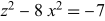 ."
Quart. J. Math. (Oxford) Ser. (2) 26, 275-278, 1975.Morgado,
J. "Generalization of a Result of Hoggatt and Bergum on Fibonacci Numbers."
Portugaliae Math. 42, 441-445, 1983-1984.Sansone, G. "Il
sistema diofanteo
."
Quart. J. Math. (Oxford) Ser. (2) 26, 275-278, 1975.Morgado,
J. "Generalization of a Result of Hoggatt and Bergum on Fibonacci Numbers."
Portugaliae Math. 42, 441-445, 1983-1984.Sansone, G. "Il
sistema diofanteo  ,
,
 ,
,
 ."
Ann. Mat. Pura Appl. 111, 125-151, 1976.Sloane, N. J. A.
Sequences
."
Ann. Mat. Pura Appl. 111, 125-151, 1976.Sloane, N. J. A.
Sequences