The cycloid is the locus of a point on the rim of a circle of radius rolling along a straight line. It
was studied and named by Galileo in 1599. Galileo attempted to find the area
by weighing pieces of metal cut into the shape of the cycloid. Torricelli, Fermat,
and Descartes all found the area. The cycloid was also studied
by Roberval in 1634, Wren in 1658, Huygens in 1673, and Johann Bernoulli in 1696.
Roberval and Wren found the arc length (MacTutor Archive).
Gear teeth were also made out of cycloids, as first proposed by Desargues in the
1630s (Cundy and Rollett 1989).
In 1696, Johann Bernoulli challenged other mathematicians to find the curve which solves the brachistochrone problem, knowing
the solution to be a cycloid. Leibniz, Newton, Jakob Bernoulli and L'Hospital all
solved Bernoulli's challenge. The cycloid also solves the tautochrone
problem, as alluded to in the following passage from Moby Dick: "[The
try-pot] is also a place for profound mathematical meditation. It was in the left-hand
try-pot of the Pequod, with the soapstone diligently circling round me, that
I was first indirectly struck by the remarkable fact, that in geometry all bodies
gliding along a cycloid, my soapstone, for example, will descend from any point in
precisely the same time" (Melville 1851). Because of the frequency with which
it provoked quarrels among mathematicians in the 17th century, the cycloid became
known as the "Helen of Geometers" (Boyer 1968, p. 389).
If the cycloid has a cusp at the origin
and its humps are oriented upward, its parametric equation is
(1)
(2)
Humps are completed at
values corresponding to successive multiples of , and have height and length . Eliminating in the above equations gives the Cartesian
equation
(3)
which is valid for
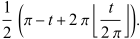
and gives the first half of the first hump of the cycloid. An implicit Cartesian
equation is given by



 rolling along a straight line. It
was studied and named by Galileo in 1599. Galileo attempted to find the area
by weighing pieces of metal cut into the shape of the cycloid. Torricelli, Fermat,
and Descartes all found the area. The cycloid was also studied
by Roberval in 1634, Wren in 1658, Huygens in 1673, and Johann Bernoulli in 1696.
Roberval and Wren found the arc length (MacTutor Archive).
Gear teeth were also made out of cycloids, as first proposed by Desargues in the
1630s (Cundy and Rollett 1989).
rolling along a straight line. It
was studied and named by Galileo in 1599. Galileo attempted to find the area
by weighing pieces of metal cut into the shape of the cycloid. Torricelli, Fermat,
and Descartes all found the area. The cycloid was also studied
by Roberval in 1634, Wren in 1658, Huygens in 1673, and Johann Bernoulli in 1696.
Roberval and Wren found the arc length (MacTutor Archive).
Gear teeth were also made out of cycloids, as first proposed by Desargues in the
1630s (Cundy and Rollett 1989).


 values corresponding to successive multiples of
  , and have height
  and length
  . Eliminating
  in the above equations gives the Cartesian
equation
in the above equations gives the Cartesian
equation

![y in [0,2a]](/images/equations/Cycloid/Inline13.svg) and gives the first half of the first hump of the cycloid. An implicit Cartesian
equation is given by
and gives the first half of the first hump of the cycloid. An implicit Cartesian
equation is given by



![4a{(-1)^(|_t/(2pi)+1/2_|)[1-|cos(1/2t)|]|sin(1/2t)|csc(1/2t)+2|_t/(2pi)+1/2_|}](/images/equations/Cycloid/Inline16.svg)