The number of ways of picking unordered outcomes from possibilities. Also known as the binomial
coefficient or choice number and read " choose ,"
where
is a factorial (Uspensky 1937, p. 18). For example,
there are
combinations of two elements out of the set , namely , , , , , and . These combinations are known as k-subsets.
The number of combinations can be computed in the Wolfram
Language using Binomial[n,
k], and the combinations themselves can be enumerated in the Wolfram
Language using Subsets[Range[n],k].
Muir (1960, p. 7) uses the nonstandard notations and .


 unordered outcomes from
  possibilities. Also known as the binomial
coefficient or choice number and read "
possibilities. Also known as the binomial
coefficient or choice number and read " choose
  ,"
,"
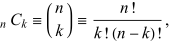
 is a factorial (Uspensky 1937, p. 18). For example,
there are
is a factorial (Uspensky 1937, p. 18). For example,
there are  combinations of two elements out of the set
  , namely
  ,
,  ,
,  ,
,  ,
,  , and
, and  . These combinations are known as k-subsets.
 can be computed in the Wolfram
Language using Binomial[n,
k], and the combinations themselves can be enumerated in the Wolfram
Language using Subsets[Range[n],
can be computed in the Wolfram
Language using Binomial[n,
k], and the combinations themselves can be enumerated in the Wolfram
Language using Subsets[Range[n], k
k ].
].
 and
and 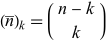 .
.
