


The Chu-Vandermonde identity
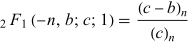 |
(1)
|
(for  )
is a special case of Gauss's hypergeometric
theorem
)
is a special case of Gauss's hypergeometric
theorem
 |  |  |
(2)
|
 |  | 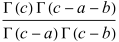 |
(3)
|
(which holds for ![R[c-a-b]>0](/images/equations/Chu-VandermondeIdentity/Inline8.svg) ), with
), with  equal to a negative integer
  .
Here,
.
Here, 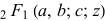 is a hypergeometric function,
  is the Pochhammer
symbol, and
is the Pochhammer
symbol, and  is a gamma function
(Bailey 1935, p. 3; Koepf 1998, p. 32). The identity is sometimes also
called Vandermonde's theorem.
is a gamma function
(Bailey 1935, p. 3; Koepf 1998, p. 32). The identity is sometimes also
called Vandermonde's theorem.
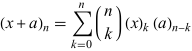
The identity
 |
(4)
|
for  an integer, where
  is a binomial coefficient
and
is a binomial coefficient
and  is again the Pochhammer symbol, is sometimes
also known as the Chu-Vandermonde identity (Koepf 1998, p. 42), or sometimes
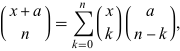
Vandermonde's formula (Boros and Moll 2004, p. 18). Equation (4)
can be written as
is again the Pochhammer symbol, is sometimes
also known as the Chu-Vandermonde identity (Koepf 1998, p. 42), or sometimes
Vandermonde's formula (Boros and Moll 2004, p. 18). Equation (4)
can be written as
 |
(5)
|
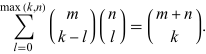
which is sometimes known as Vandermonde's convolution formula (Roman 1984). A special case gives the identity
 |
(6)
|
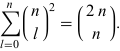
The most famous special case follows from taking  and using the identity
 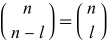 in (6) to obtain
 |
(7)
|
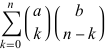
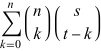
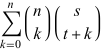
The identities
 |  |  |
(8)
|
 |  |  |
(9)
|
 |  |  |
(10)
|
are all special instances of the Chu-Vandermonde identity (Koepf 1998, p. 41).
