An arithmetic series is the sum of a sequence, , 2, ..., in which each term is computed from the previous
one by adding (or subtracting) a constant . Therefore, for ,
(1)
The sum of the sequence of the first terms is then given by
or
times the arithmetic mean of the first and last
terms! This is the trick Gauss used as a schoolboy to solve the problem of summing
the integers from 1 to 100 given as busy-work by his
teacher. While his classmates toiled away doing the addition
longhand, Gauss wrote a single number, the correct answer
(11)
on his slate (Burton 1989, pp. 80-81; Hoffman 1998, p. 207). When the answers were examined, Gauss's proved to be the only correct one.


 ,
,  , 2, ..., in which each term is computed from the previous
one by adding (or subtracting) a constant
, 2, ..., in which each term is computed from the previous
one by adding (or subtracting) a constant  . Therefore, for
  ,
,

 terms is then given by


![sum_(k=1)^(n)[a_1+(k-1)d]](/images/equations/ArithmeticSeries/Inline11.svg)


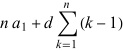


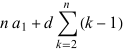


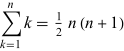
![S_n=na_1+1/2dn(n-1)=1/2n[2a_1+d(n-1)].](/images/equations/ArithmeticSeries/NumberedEquation3.svg)
![a_1+a_n=a_1+[a_1+d(n-1)]=2a_1+d(n-1),](/images/equations/ArithmeticSeries/NumberedEquation4.svg)
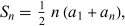
 times the arithmetic mean of the first and last
terms! This is the trick Gauss used as a schoolboy to solve the problem of summing
the integers from 1 to 100 given as busy-work by his
teacher. While his classmates toiled away doing the addition
longhand, Gauss wrote a single number, the correct answer
times the arithmetic mean of the first and last
terms! This is the trick Gauss used as a schoolboy to solve the problem of summing
the integers from 1 to 100 given as busy-work by his
teacher. While his classmates toiled away doing the addition
longhand, Gauss wrote a single number, the correct answer

